

Lead Demand
Practical guides, checklists and decision frameworks for this marketing and revenue topic.
Scale Orbit Editorial
Research and practical guidance from our team
This editorial library contains articles prepared for Scale Orbit and reviewed by our team before publication. It is separate from Community Publications, where independent authors and practitioners publish under their own profiles and follow a dedicated moderation process.
-
Architecture Firm Lead Generation: Qualify Projects Before the Proposal
A project-fit framework for architecture practices to assess client, place, phase, procurement, effort, and capacity before writing a proposal.
-
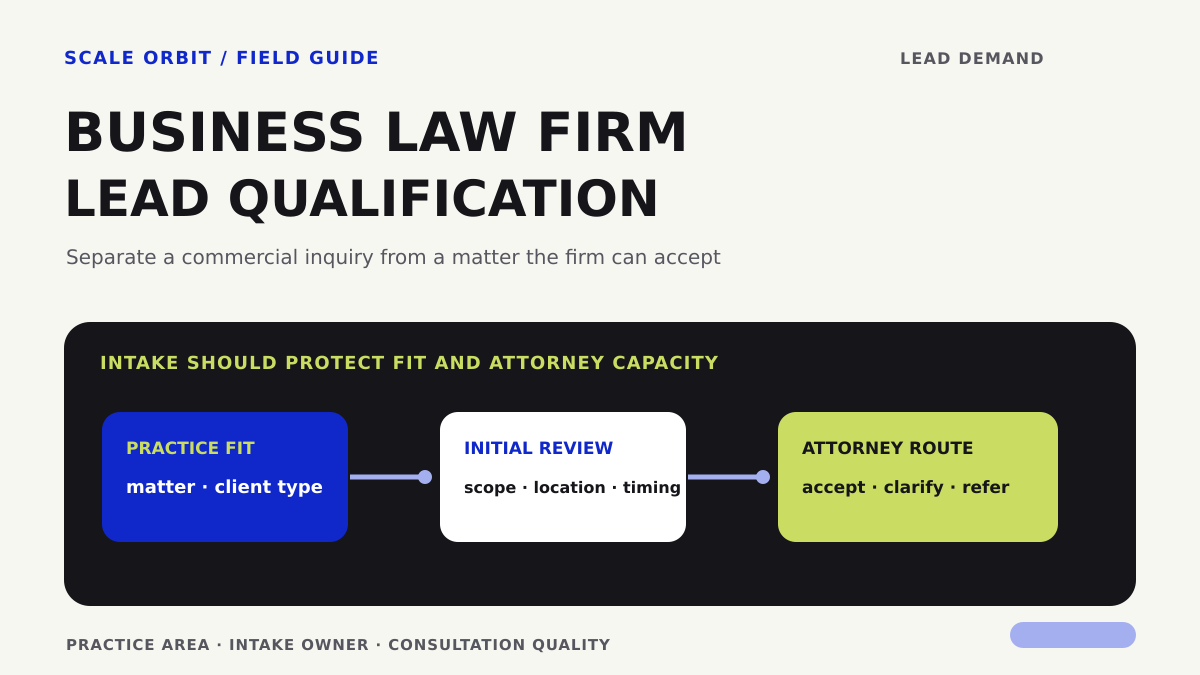
Business Law Firm Lead Generation: Qualify Commercial Matters Before Intake
A safer, more useful marketing-to-intake path for commercial law firms, from practice-area fit to an attorney-approved next step.
-
Private School Enrollment Marketing: Connect Inquiries to Confirmed Enrollment
A capacity-aware enrollment funnel for private schools that connects family interest, visits, applications, admissions decisions, and confirmed enrollment.
-
Commercial Real Estate Lead Generation: Qualify the Brokerage Mandate
A practical intake model for commercial brokers to separate a property inquiry from a viable mandate, route it correctly, and measure opportunity…
-
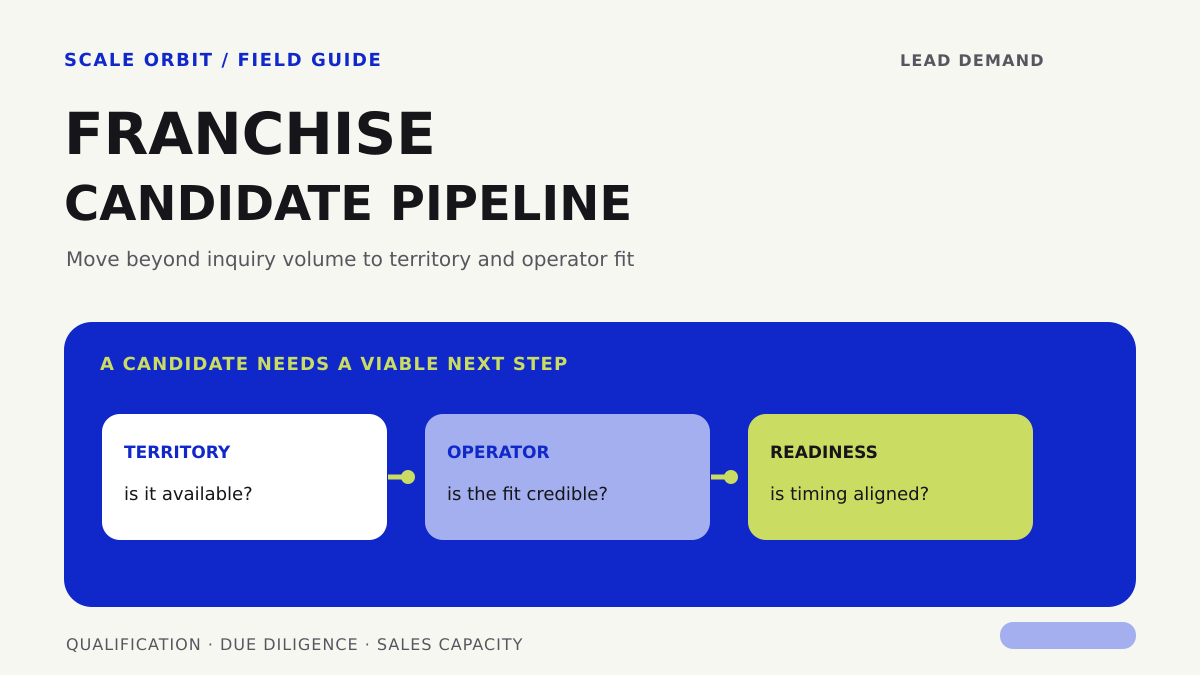
Franchise Lead Generation: Qualify Candidates by Territory, Fit, and Readiness
A framework for franchise brands to assess candidate fit, territory availability, readiness, and pipeline progress before expanding acquisition.
-
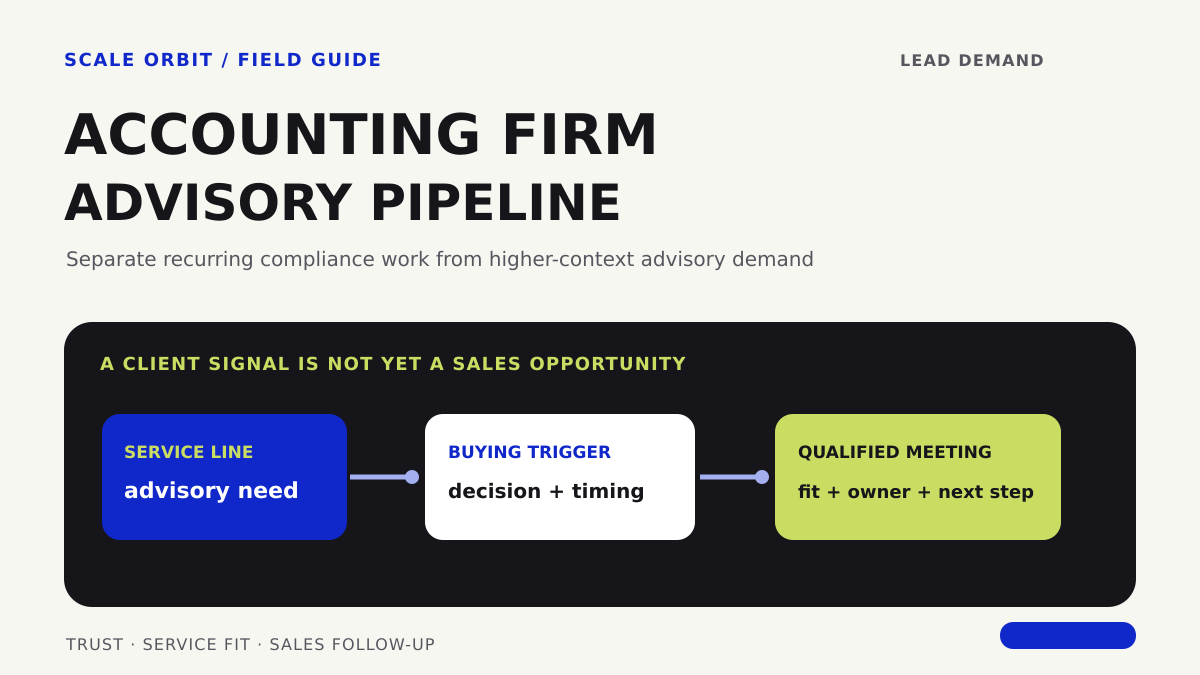
Accounting Firm Lead Generation for Advisory Services: Qualify Need Before the Call
How accounting firms can generate better advisory inquiries by separating service lines, buyer triggers, qualification, and follow-up.
-
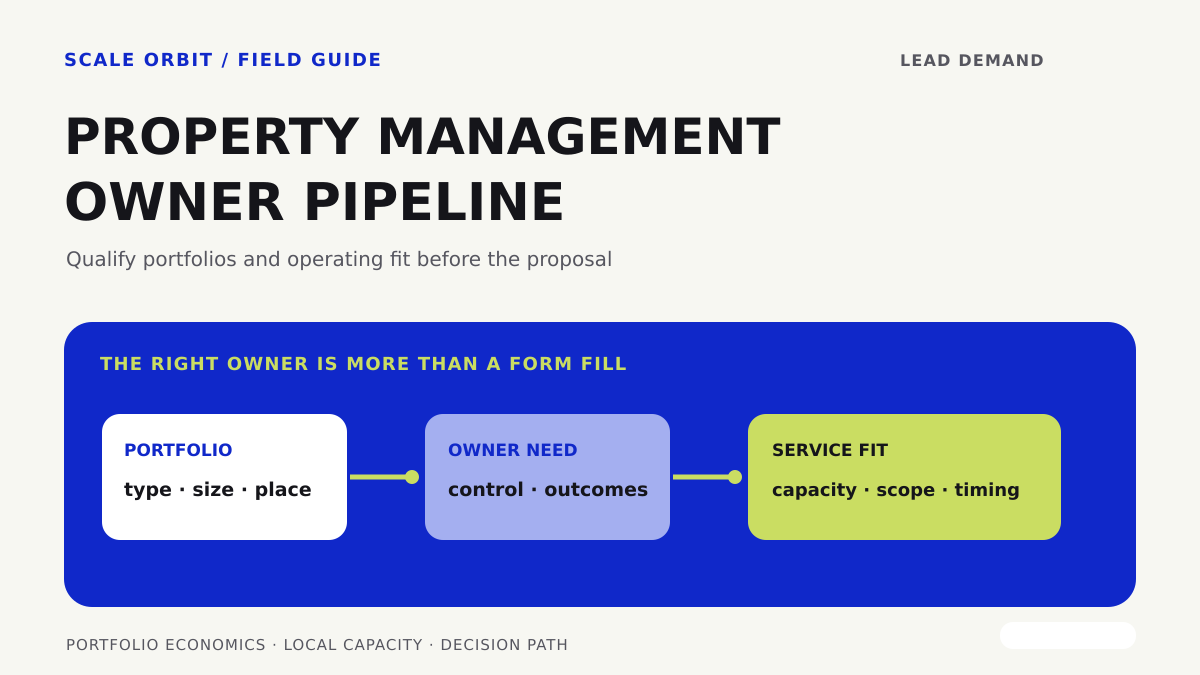
Property Management Lead Generation: Qualify Owner Portfolios Before the Proposal
A qualification framework for property management companies seeking owner clients whose portfolios and operating needs fit the services they can deliver.
-
Roofing Lead Generation: Qualify Inspections Before Estimates
A practical framework for roofing companies to route the right inspection requests, protect estimator capacity, and learn from completed jobs.
-
Moving Company Lead Generation: Qualify the Move Before You Quote
A practical inquiry and quoting framework for moving companies, from move details and service fit to booked work and completed-job reporting.
-
Pest Control Marketing Strategy: Separate One-Time Service From Recurring Plans
A service-line framework for pest control businesses that need to route immediate requests, recurring-plan interest, and commercial opportunities differently.
-
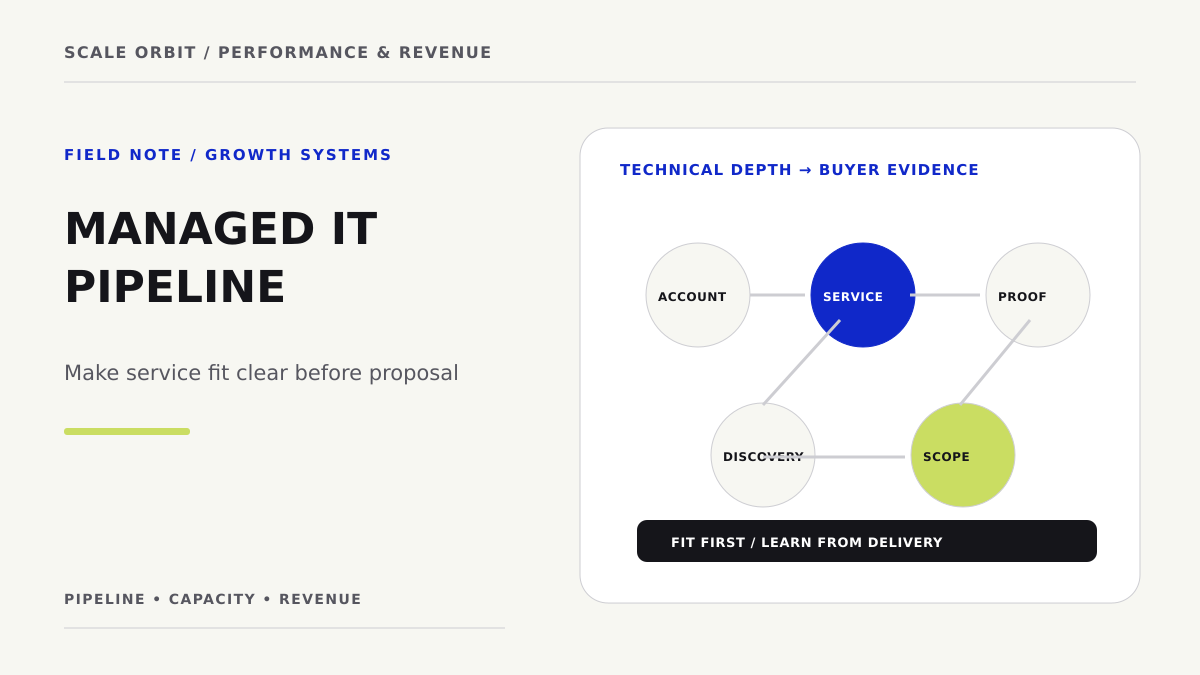
Managed IT Services Marketing: Build a Pipeline Around Service Fit
A pipeline framework for managed service providers that turns technical capabilities into relevant buyer evidence and service-fit conversations.
-
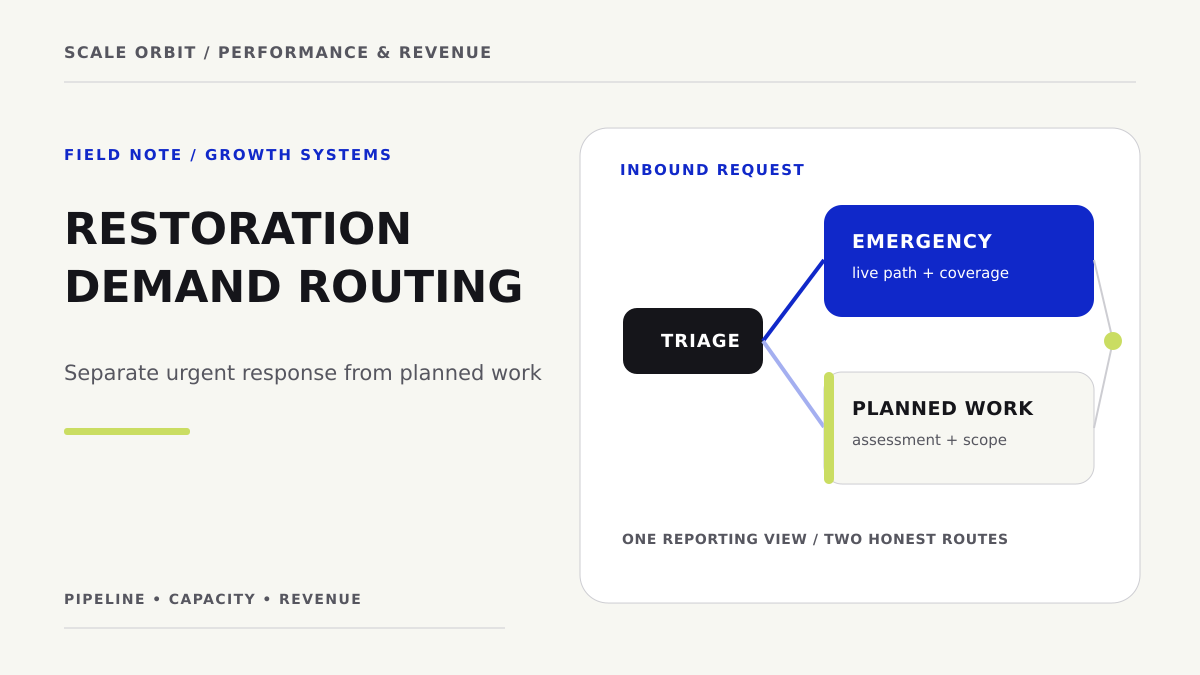
Water Damage Restoration Marketing: Route Emergency and Planned Demand
Emergency calls and planned restoration projects need different entry points, owners, and performance measures. This framework connects both to service capacity.
-
Solar Company Lead Generation: Qualify Projects Before the Site Visit
A qualification framework for solar companies that separates initial interest from projects ready for a serious assessment and proposal.
-
HVAC Marketing Strategy: Match Demand to Service Capacity
A practical framework for HVAC companies to align repair, replacement, maintenance, and commercial demand with real service capacity.
-
B2B EdTech Demand Generation: Build a Pipeline for Institutional Buyers
A B2B demand-generation framework for EdTech teams selling to institutions, with buyer-group mapping, pilot evidence, procurement readiness, and a distinct student-enrollment motion.
-
Cybersecurity Demand Generation: Turn Technical Evidence Into Sales-Ready Opportunities
Build cybersecurity demand around a clear buyer trigger, role-specific evidence, credible evaluation steps, and a sales handoff grounded in observable readiness.
-
Healthcare Patient Acquisition Strategy: Balance Local Demand With Appointment Capacity
Plan healthcare marketing around a defined service line, reachable local demand, workable scheduling, attended appointments, and privacy-aware measurement.
-
Logistics Marketing Strategy: Build Pipeline Around Service Fit
Build logistics demand around service fit, buyer needs, quote qualification, sales routing, and verified commercial outcomes.
-
B2B Field Marketing: Build Regional Programs That Create Sales Conversations
Plan regional B2B field programs around target accounts, local activations, sales follow-through, and pipeline evidence—not event attendance alone.
-
MQL-to-SQL Conversion Rate: Formula, Cohorts, and Diagnosis
Measure MQL-to-SQL progression with a clear cohort formula, matched stage definitions, a fair observation window, and separate reporting for sales acceptance and…
-
Target Market vs. Target Audience vs. ICP: Scope, Examples, and Use
Separate a broad market, a campaign audience, and an ideal customer profile to improve B2B targeting and measurement.
-
Owned vs. Earned vs. Paid Media: How Distribution Channels Differ
Understand owned, earned, and paid media, their trade-offs, and how to combine distribution without double-counting reach.
-
Gated vs. Ungated Content: Choose a Lead Capture Model
Compare gated and ungated content by audience access, search visibility, lead capture, and measurement to choose a model that fits the asset’s…
-
Psychographic vs. Behavioral Segmentation: What Each Reveals
Compare psychographic and behavioral segmentation, identify appropriate data sources, and combine motivations with observed actions without overclaiming.
-
Webinar Registrations vs. Attendance Rate: Measure the Full Event Funnel
Learn how to define webinar registration and attendance rates, identify drop-off points, and compare event performance without relying on signup volume alone.
-
Firmographic vs. Technographic Data: Choose B2B Segments That Fit
Compare firmographic and technographic data for B2B segmentation, assess data quality, and combine both without treating a signal as proof of intent.
-
Lead Gen Forms vs. Website Forms: Compare Friction, Control, and Lead Quality
Compare native lead forms with website forms by signup friction, data control, qualification, follow-up, and how to measure lead quality.
-
Marketing Qualified Account (MQA): Definition and Criteria
Learn what a marketing qualified account is, how MQA criteria differ from MQLs, and how to define account-level qualification without relying on…
-
How to Map a B2B Buying Committee
Map a B2B buying committee by decision role, evidence, and open questions. This framework helps teams understand stakeholder coverage without guessing from…
-
B2B Association Sponsorships: Compare Member Access and Referral Outcomes
Evaluate association sponsorships by member access, audience fit, participation, and referral quality—not logo visibility alone.
-
Buyer Champion Enablement: Give Internal Advocates Evidence They Can Reuse
Help an internal buyer advocate explain a decision with concise, verifiable evidence tailored to different stakeholders.
-
B2B Marketplace Leads: Track Discovery, Trials, and Partner Ownership
Marketplace demand can flow through a listing, trial, inquiry, or reseller. Record the buyer path before comparing it with direct website leads.
-
B2B Benchmark Reports: Design Sampling and Comparisons Readers Can Trust
Benchmarks are useful when readers can see who was measured, how metrics were defined, and where the comparison does not apply.























Need help choosing the next marketing action?
Describe the acquisition, measurement or pipeline problem you need to solve. Scale Orbit will review the context and identify a useful next step.
About this topic
This Lead Generation library covers the creation, capture and qualification of demand for companies that need more useful sales conversations rather than a larger volume of unqualified contacts. Topics include B2B lead generation, high-intent acquisition, demand generation, account-based marketing, appointment setting, webinar acquisition, offers, forms, lead magnets, qualification criteria and the follow-up required to convert initial interest into pipeline.
Use these guides to evaluate audience fit, buying intent, channel selection, message clarity, landing-page alignment, lead scoring and response speed. The articles help diagnose why campaigns may produce clicks or form submissions without enough sales-qualified leads, meetings or opportunities. They also explain how to distinguish demand creation from demand capture and how to set expectations for channels with different time horizons.
This section is designed for founders, marketing leaders, growth teams and sales organisations that want a measurable lead-generation system. The focus is on improving lead quality, cost per qualified opportunity, meeting conversion and pipeline contribution while preserving enough context in the CRM to understand which acquisition decisions are producing commercial value.