

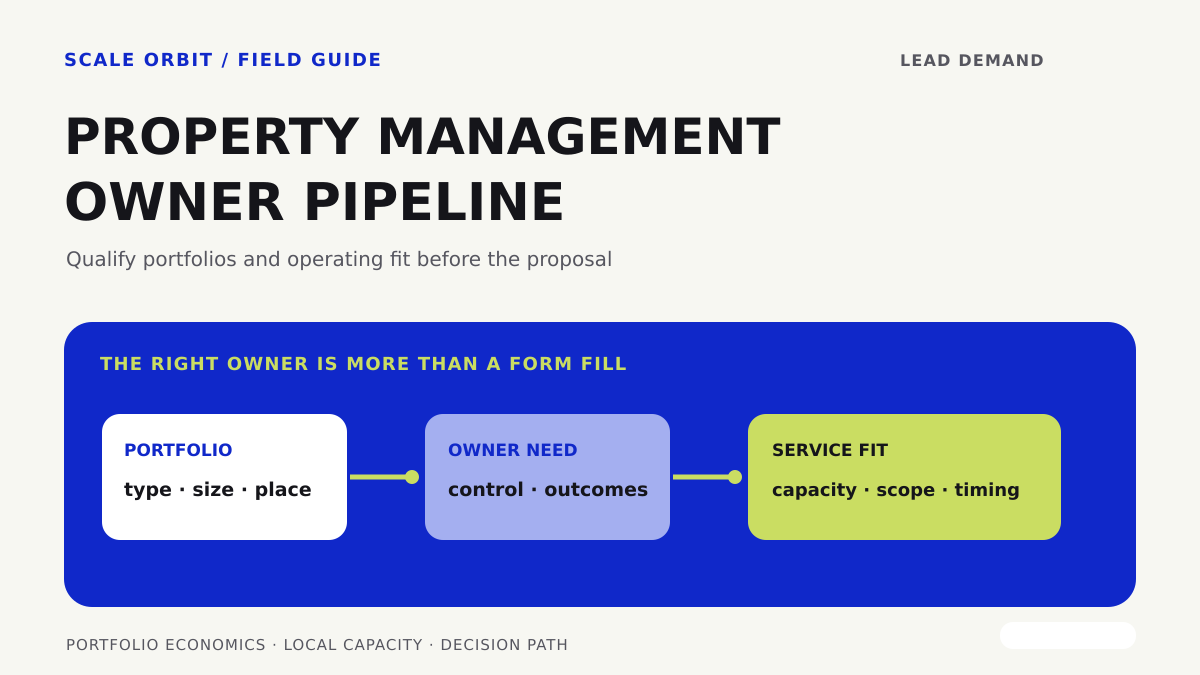
For a property management company, a lead is not valuable simply because someone owns a property. The prospective owner’s asset type, geography, operating needs, decision process, and transition timing all affect whether the company can serve the portfolio well. Lead generation should help both sides identify fit before the team spends time preparing a proposal.
In brief: define the property and owner profiles the business can support, make service boundaries visible, and qualify the portfolio and decision path before pricing. Measure the pipeline by suitable discovery conversations and mandates—not by raw inquiries alone.
Define the owner and portfolio you can serve
Start with operational coverage rather than a broad audience label. Document the property types handled, locations served, portfolio complexity, services available, and any work that requires a partner or specialist. A company with strong residential operations may not have the systems or team for a complex commercial portfolio. A regional provider may not be able to respond consistently outside its service area.
There is no universal portfolio size that makes an owner a fit. The right threshold depends on service economics, local coverage, staff capacity, existing vendor relationships, and the owner’s expectations. Write these constraints down internally so marketing does not promise a scope the operations team cannot support.
Lead with the owner’s operating problem
Owners may be looking for better reporting, more reliable maintenance coordination, tenant communication, leasing support, or a change in day-to-day oversight. Explain which of those jobs the company performs and what information it needs before proposing a service. Avoid unsupported claims about guaranteed rent, occupancy, or property value; communicate the work and service process the company controls.
A useful page gives a prospect enough detail to self-identify: property types, geography, service scope, what a first assessment covers, and what the company does not provide. Specificity reduces mismatched inquiries and makes it easier for a relevant owner to start a conversation.
Qualify five dimensions before preparing a proposal
The first conversation should clarify the portfolio and the conditions around a potential transition. The questions below can be asked progressively; the initial form does not need to contain every detail.

- Portfolio: property types, number of locations or units where relevant, and geography.
- Operating scope: the services requested and any work that remains with the owner or another provider.
- Owner objective: the problem that prompted the search and what a satisfactory operating relationship would look like.
- Service capacity: whether the company has local coverage, staff, and vendor capacity for the requested scope.
- Decision path: who approves a change, what information is needed, and when a transition could be considered.
Match acquisition to local service capacity
Referrals, owner and investor networks, search, educational content, and paid media can all contribute to demand. Their roles differ: a referral may arrive with context, search may capture an active management need, and educational content may help an owner understand a service before comparing providers. Regardless of source, the intake process should capture geography and property fit early enough to route inquiries correctly.
Create pages around real service lines and areas the team can support. Avoid producing near-identical location pages that do not explain local coverage or a real difference in the service. If a new market is only an idea, validate operations and ownership before marketing it as available.
Use pipeline stages that reflect a mandate
A practical CRM flow might be inquiry received, portfolio fit checked, discovery scheduled, discovery completed, assessment or scope prepared, proposal issued, and won, deferred, or declined. A tenant-service request should be routed separately from an owner acquisition inquiry unless tenant support is itself part of the marketing program.
Record the property fit, service need, source, decision owner, timing, and reason the opportunity stopped. This gives the team a basis to improve audience, page content, and qualification. It also helps leadership see whether marketing demand is aligned with available managers and operational coverage.
For a wider service-business pipeline model, see Scale Orbit’s professional-services marketing strategy. Its emphasis on clear qualification and follow-up can be adapted to a property-management mandate.
Review demand and delivery together
A high inquiry count can be a poor result if the portfolio mix falls outside the company’s coverage. Review suitable inquiries, completed discovery calls, proposal readiness, accepted mandates, and operational capacity alongside spend. If many prospects are declined for the same reason, adjust the targeting or make the scope clearer before expanding acquisition.
Property management lead generation works best when a marketing promise matches the service operation. Define where and what the company can manage, make that visible before the inquiry, and qualify the owner’s portfolio before the team commits to a proposal.
How did this article land?
Choose one reaction. You can change it anytime.