

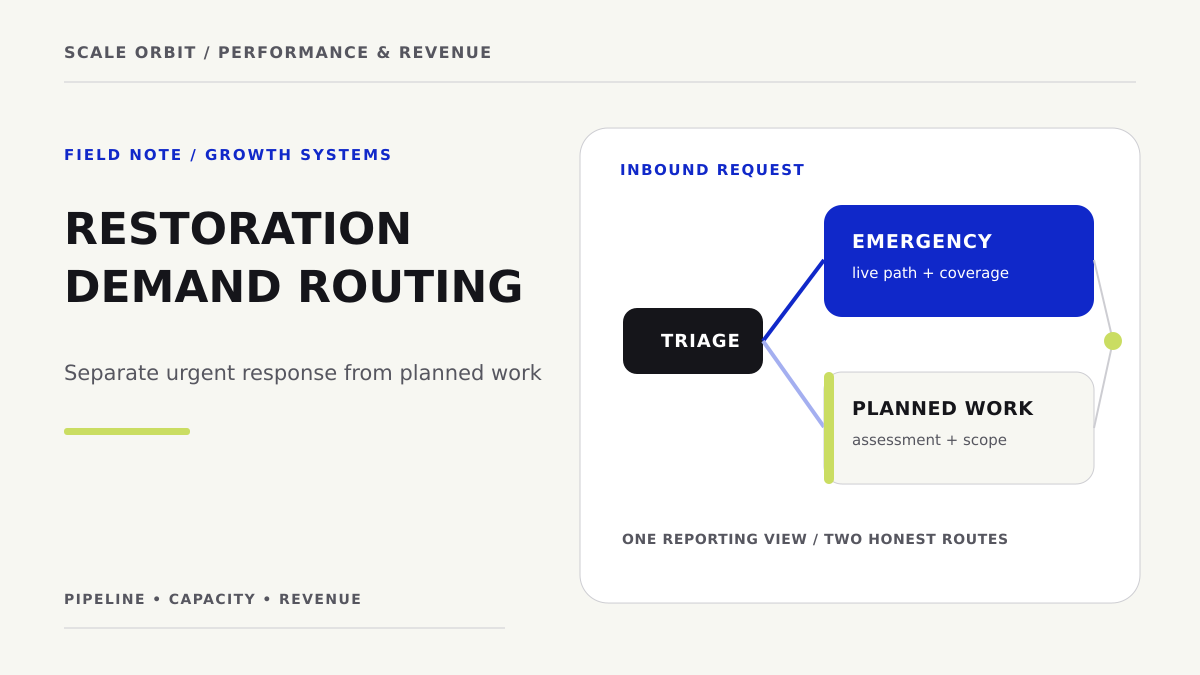
Water damage restoration demand can arrive at very different moments. One person may need help with an active incident; another may be comparing contractors for a project that is already stabilized. Sending both through the same form, queue, and follow-up schedule makes the experience harder for the buyer and the operation.
A stronger marketing system separates urgent response from planned work at the point where the next action changes. The company still needs one accountable view of results, but the two routes should preserve their different timing, qualification, and dispatch needs.

Triage for the next decision
The first interaction should establish whether the company can serve the location and whether the request requires an immediate human response under its operating model. The aim is not to diagnose damage through an advertisement. It is to route the person to an appropriate next step and avoid implying availability that the team cannot provide.
- Active or time-sensitive request: present the approved contact path, confirm coverage, and route it to the person responsible for the current response schedule.
- Stabilized or planned project: gather enough context to assign an assessment or estimate path, then set an honest expectation for follow-up.
- Outside coverage or unsupported work: tell the requester plainly and record the reason, so the same mismatch can be prevented upstream.
Keep emergency and planned routes distinct
The campaign and page should reflect the route the operation can honor. A fast-response message belongs only where a live contact path and dispatch coverage exist. For planned work, give more space to process, scope, and what an assessment will establish. Referral partners may need a third route with a named recipient and a way to confirm whether the request was accepted.
| Demand source or context | Useful message | Routing check |
|---|---|---|
| Urgent search or call | What to do now and how to reach the covered response path | Is a live owner available for this location and time? |
| Planned project research | What the assessment covers and what information helps | Is there a project owner and an agreed follow-up step? |
| Partner referral | Which work the company accepts and who receives it | Can the partner confirm receipt and outcome? |
Urgent demand is sensitive to operating hours, on-call coverage, and dispatch capacity. If those are limited, campaigns and landing pages need to reflect the real window for response. A contact form that is checked later should not be presented as an emergency channel. For planned work, the buyer may be comparing scope, timing, and providers; a useful route can offer an assessment request with a clear explanation of what information helps.
Separate routing does not require separate brands or a complicated technology stack. It requires clear labels, accountable owners, and CRM fields that preserve the request type. Track the first human response using a consistent business calendar; this guide to measuring first response time explains why the clock needs an agreed definition.
| Design choice | Emergency route | Planned-project route |
|---|---|---|
| Primary next step | Approved live contact or dispatch process | Assessment or estimate request |
| Qualification focus | Serviceability, contact, urgency, current coverage | Project stage, property context, scope, timing |
| Owner | On-call or response lead | Estimator, project lead, or sales owner |
| Useful status | Contacted / routed / dispatched / unable to serve | Assessment set / scoped / estimated / accepted or declined |
Make the service promise match the operation
Review every public promise against the actual service model: coverage map, hours, supported job types, escalation path, and current capacity. If coverage varies by location or time, say so in the relevant route. The message should help someone understand what happens next; it should not create a blanket response commitment that the team has not approved.
This is also where a clean path for unserviceable demand matters. Rather than leaving an unqualified request in the queue, use a clear handoff or close-out rule and record why it could not proceed. The broader method in handling inbound requests the business cannot serve can be adapted to service coverage and job-type boundaries.
Connect marketing to completed work
Report a chain that can be reconciled: inquiry source, request type, serviceability, response, dispatch or assessment, accepted work, completion, and recorded revenue. Keep the two routes visible in reporting. Otherwise a large number of urgent contacts can obscure a weak planned-project pipeline—or planned inquiries can make a response operation look healthier than it is.
Do not equate a call, form, or dispatch with a completed job. Where phone and CRM data are incomplete, label that gap. Optimize only to the deepest reliable stage available, then improve the handoff that would make a later stage measurable.
A practical first review
Take one recent set of inquiries and sort it into three groups: emergency response, planned work, and not serviceable. For each group, identify who owned the next action, whether the buyer received it, and whether the request reached an operational outcome. Fix the largest routing ambiguity before adding another campaign or lead source.
The objective is a single view of demand with two honest paths: one that protects the urgent response process and one that gives planned work enough context to qualify. For broader guidance on evaluating inquiry quality, see why qualified conversations matter more than form volume.
How did this article land?
Choose one reaction. You can change it anytime.