

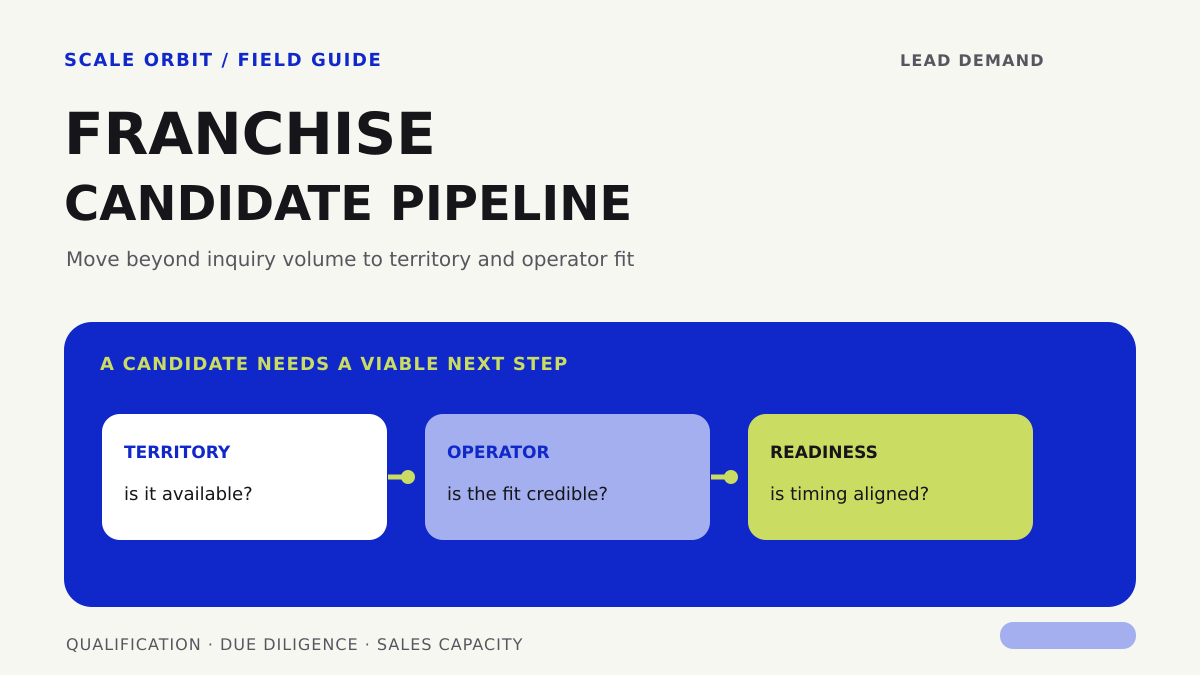
A franchise inquiry is an expression of interest, not proof that a candidate can or should advance. A useful franchise development pipeline has to connect the person’s goals and operating capacity with a territory the brand can support and a process the development team can manage.
In brief: define what “fit” means for the brand, capture territory and timing context early, route candidates to an owner, and measure progress through qualified conversations and documented next steps. Do not equate a form submission with a viable candidate.
Define candidate fit before buying more demand
Candidate fit is specific to the franchise model. It may involve the candidate’s operating role, relevant experience, ability to lead a team, desired level of involvement, geography, and readiness to evaluate the business. These criteria should reflect the actual operating model and the development team’s capacity, not a generic list copied across every brand.
Separate essential fit criteria from information that can wait. A first inquiry can capture the market of interest, preferred timing, relevant operating experience, and whether the person expects to be an owner-operator or a different role. Avoid requesting detailed financial records through an unqualified marketing form; define a suitable, secure process with the responsible team.
Make territory and availability visible
Territory context affects whether a candidate can move forward. Marketing pages and inquiry routes should explain how the brand handles markets and what the next step is for checking availability. Keep availability information current and assign an owner to update it. If a territory is under review or unavailable, do not let a campaign continue to imply that it is open.
Where the brand supports several markets, use location-specific information only when the business can substantiate it and the operating model truly differs. Content should help candidates understand the business, responsibilities, and evaluation process without implying guaranteed returns or a predictable outcome.
Build a staged qualification journey
The purpose of qualification is not to create friction. It is to help the candidate and the brand decide what to learn next. An illustrative path is inquiry, fit conversation, territory and operating validation, then a defined next decision. The actual stages and documents depend on the brand and the requirements that apply in each market.

At each transition, record the evidence the team needs before advancing: fit criteria clarified, owner assigned, territory checked, information provided through the appropriate process, and next action accepted by both sides. If a candidate is not ready or the market cannot be served, record that outcome and close or defer the record cleanly.
Give each channel a defined role
Search and comparison content can help candidates with active franchise questions. Educational material can explain the brand’s operating model and evaluation process. Events and referrals may support deeper conversations when the development team has a clear follow-up owner. Paid media can test messaging and generate inquiries, but its value should be assessed by candidate progression and fit—not by low cost per form submission.
Use claims that the brand can substantiate and that have been reviewed for the markets where they appear. Avoid unsupported earnings, growth, payback, or success statements. Franchise sales, disclosures, privacy, and advertising requirements vary by jurisdiction and business model; have qualified counsel review the process, materials, and representations before launch.
Track a pipeline the development team can use
Keep inquiry volume separate from qualified pipeline. A practical CRM should capture source, market or territory, fit status, owner, stage, last meaningful interaction, and the next action. Use a clear reason code for unqualified, deferred, duplicate, or unavailable-market records. This makes it possible to identify whether the constraint is audience, message, territory, responsiveness, or process capacity.
Review measures such as completed fit conversations, candidates with a plausible territory path, progression to the next defined review stage, and agreements or other outcomes that the business can verify. Compare candidate cohorts over a period appropriate to the development cycle; short-term lead counts may not represent final commercial value.
Pipeline design should also reflect sales capacity. Scale Orbit’s guides to B2B sales capacity planning and a usable B2B sales cadence offer related methods for assigning ownership and keeping follow-up consistent.
Align acquisition with market and team capacity
Before increasing spend, confirm that the brand has territories to discuss, trained staff to respond, a defined evaluation process, and a way to preserve candidate history. If one of these is missing, resolve that constraint first. More inquiries cannot compensate for unavailable markets or unclear follow-up.
Franchise lead generation is strongest when it helps the right candidate take an informed next step while protecting the development team’s time. Define fit, check territory, route follow-up, and measure progress through the pipeline. Keep commercial claims accurate and review jurisdiction-specific requirements with qualified counsel.
How did this article land?
Choose one reaction. You can change it anytime.