

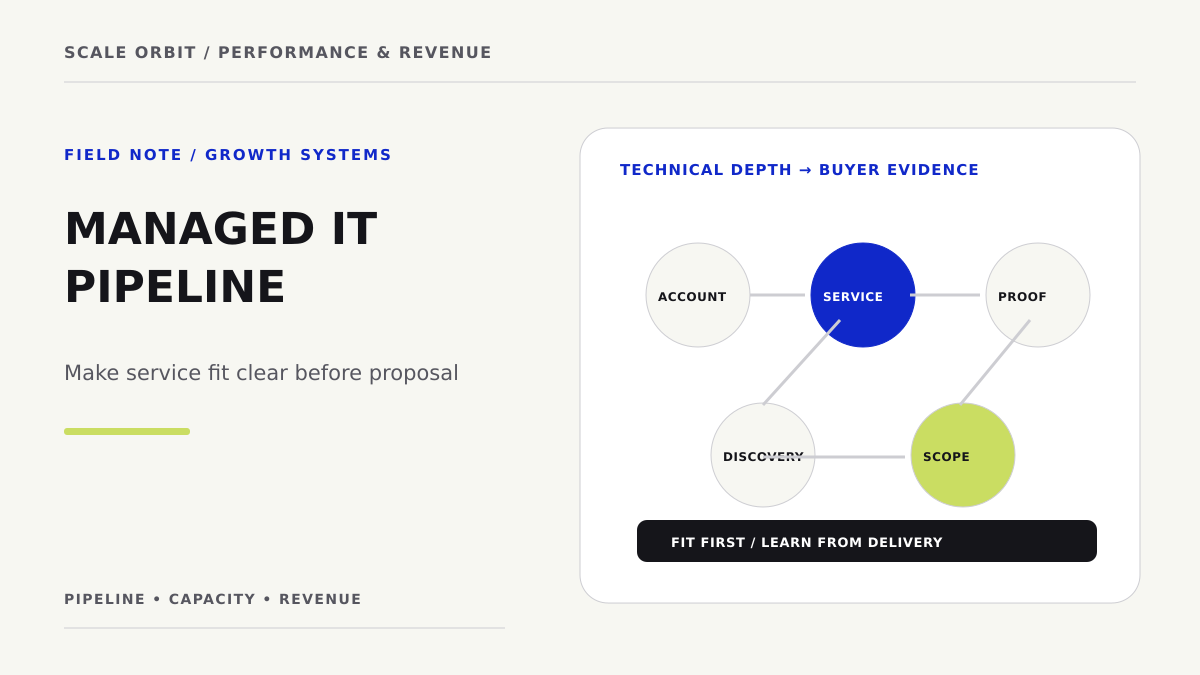
Managed IT services marketing has a translation problem. Buyers may need dependable support, a clearer operating model, or help with a specific environment, while providers often describe tools, certifications, and technical capabilities first. The technical detail matters, but it becomes useful in demand generation when it helps a buyer understand fit, risk, scope, and the next decision.
A pipeline should make the service boundary visible before a proposal is built. That means choosing an account profile, explaining what the service includes, and giving sales a way to distinguish real service-fit conversations from general interest.

Choose a segment the service team can support
Define the segment by operating conditions, not by a broad label such as “small business.” Useful dimensions may include geography, current IT ownership, operating complexity, support expectations, regulatory or security requirements where relevant, and the type of transition the provider can manage. Use the service team’s delivery experience to decide which conditions matter.
| Commercial question | Evidence the buyer can evaluate |
|---|---|
| What work is included? | A plain-language service boundary, responsibilities, and exclusions |
| How does support work? | An accurate explanation of contact paths, escalation, and ownership |
| How is transition handled? | A documented discovery and onboarding sequence that matches delivery |
| What makes the provider a fit? | Relevant experience and proof tied to the buyer’s environment—not generic claims |
Keep descriptions aligned with actual contracts and delivery. Do not imply a universal response time, service level, or security outcome unless the company can document and honor it. For cybersecurity topics, connect the evidence to the buyer’s risk question; the cybersecurity demand generation guide covers how to make technical evidence relevant to a sales conversation.
Show evidence that answers buyer risk
| Buyer stage | Useful marketing evidence | Sales handoff |
|---|---|---|
| Early exploration | Plain-language service model and boundary | Clarify the current operating model and trigger for change |
| Provider comparison | Responsibility map, onboarding outline, and relevant reference | Confirm requirements and stakeholders |
| Technical review | Accurate documentation and scoped discovery agenda | Route technical questions to an accountable specialist |
Use the same evidence library across pages, sales follow-up, and discovery preparation. If a claim depends on a specific contract, environment, or configuration, state that condition. Credibility comes from making the boundary legible, not from promising a result before the team has evaluated the environment.
Useful evidence can include a clear scope map, sample onboarding plan, team responsibilities, escalation model, security documentation, references, or a case study with verified facts. Explain what each item does and where its limits are. A checklist can help a buyer prepare for discovery; it should not be presented as a guarantee that an environment is secure or ready for migration.
Build content around decisions at different stages: a practical comparison for early evaluation, a service-fit checklist for active research, and implementation detail for stakeholders reviewing a transition. The objective is to answer the question the buyer is trying to resolve, not publish an inventory of every tool the provider uses.
Qualify accounts and needs without overloading the form
The first inquiry should make it possible to respond and understand the likely need. On a conversation, the team can clarify current support ownership, environment, pain or change event, locations involved, decision participants, and timing. Ask in a sequence that respects what the buyer knows; not every prospect can provide technical inventory before speaking with a provider.
- Use explicit service-fit statuses: eligible, needs discovery, out of scope, or refer elsewhere.
- Record why an opportunity advances or stops, including a mismatch between promised scope and delivery capability.
- Route technical questions to a person who can answer them accurately; avoid automated copy that implies a guarantee.
Define what counts as a qualified opportunity
A marketing-qualified response is not automatically an opportunity for a managed service contract. Define a qualified opportunity in terms sales and service leadership can observe: a relevant organization, a need the provider can address, a plausible path to decision, and an agreed next step. Avoid making employee count or a form score the sole determinant unless the company has evidence that it predicts fit.
Write down acceptance, follow-up, and rejection expectations in the sales and marketing handoff agreement. A shared definition makes it easier to review lead quality without relying on anecdotal disagreements.
Measure from conversation to delivery
Report inquiries, qualified discovery meetings, scoped opportunities, proposals, signed agreements, and onboarding progress as separate stages. Add reasons for loss or delay, such as service mismatch, timing, incumbent contract, stakeholder alignment, or transition risk. Use cohorts that allow the team to see a long sales journey; do not credit a channel with signed revenue before the CRM record supports the connection.
At review, ask two questions: which source is producing conversations that delivery can support, and which evidence helps those conversations progress? That directs effort toward account quality and buyer confidence rather than raw lead count.
A useful first build
Choose one segment, write its service boundary in buyer language, assemble evidence delivery is willing to stand behind, and map each incoming request to an owner and next step. Then review the first set of accepted and declined opportunities with both marketing and service leadership. That feedback loop makes the pipeline more accurate before the company expands its channel mix.
How did this article land?
Choose one reaction. You can change it anytime.