

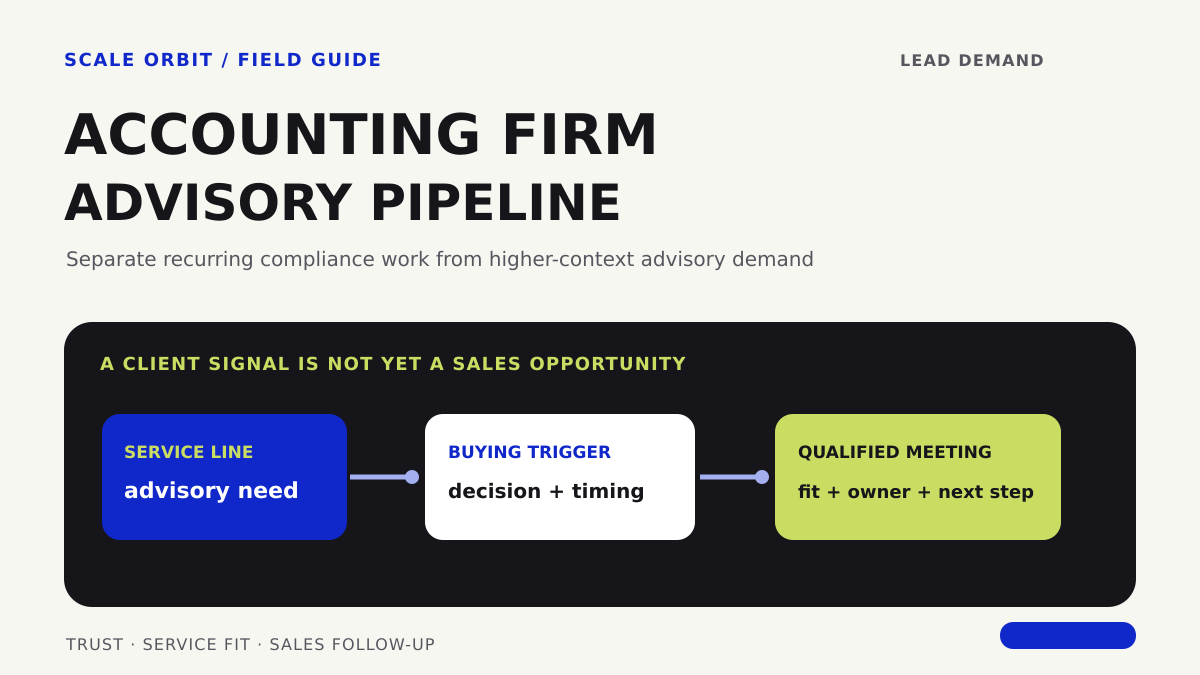
Accounting firms often describe a broad set of capabilities on one website and send every inquiry to the same contact form. That makes the next conversation harder than it needs to be: a person looking for recurring compliance support may have a different need, timing, decision process, and service fit from a company seeking planning or transaction advice.
The practical fix: organise lead generation around the service being considered and the event or decision that created the need. Then qualify enough context to route the inquiry to the right person. A contact is not a qualified advisory opportunity until service fit, decision ownership, and a realistic next step are clear.
Separate service demand before choosing a channel
Start with the firm’s actual capacity and strategic priorities. A firm may want more work in a particular service line, but marketing cannot create a useful pipeline if the delivery team cannot take on the work or the firm has not defined which clients it serves best.
Map each priority service to a distinct buyer question. Tax and compliance demand may begin with a recurring obligation or a change in business circumstances. Controller or bookkeeping support may begin with unreliable close processes or limited internal capacity. CFO and advisory work may begin when leadership needs a forecast, financing plan, or operating decision. These are different entry points; do not treat them as one generic “accounting help” request.

Build a useful inquiry path for each service
A landing page or service page should help a potential client recognise the problem, understand the kind of support offered, and decide whether a conversation is appropriate. Explain the scope in plain language. Where a service has limits or depends on facts the firm must review, state that a first inquiry is a fit discussion, not a completed assessment.
The page does not need a long form. Collect only information needed to route and prepare for the first conversation. Depending on the service, that could include organisation type, approximate complexity, the service of interest, the event or problem, timing, and the person’s role. Avoid asking prospects to submit sensitive records through a marketing form; arrange secure transfer only when the firm has established fit and a proper process.
Qualify the trigger, owner, and next step
Before an adviser commits time, someone should establish what prompted the inquiry, who is involved in the decision, and what needs to happen next. A concise qualification conversation can clarify the following:
- Which service is the prospect considering, and what is explicitly outside the request?
- What decision, change, or recurring need prompted the conversation?
- Who will decide, who will provide information, and who else must be involved?
- When does the prospect need a useful answer, and what dependencies could affect timing?
- Is the request within the firm’s service scope, capacity, and target client profile?
A “not now” or “not a fit” outcome is useful when recorded consistently. It prevents marketing from reporting every submission as success and helps the firm see which service pages attract the wrong expectation.
Give channels distinct jobs
Referrals and professional networks can create trust for complex advisory work, but the firm still needs a clear intake and follow-up process. Search-oriented content can answer a specific decision question before a buyer is ready to speak. Events and educational sessions can help explain a service, provided the content does not turn into a disguised promise of a financial outcome. Paid campaigns may help test an offer or reach a defined audience, but they should be evaluated on qualified consultations and signed work—not cheap form fills.
Choose a channel only after confirming that the service, page, intake, and follow-up are ready. If a partner cannot respond promptly or the firm has no method to assign inquiries, increasing traffic will magnify the operational bottleneck.
Track progress from inquiry to signed engagement
Use a small set of stages the team can apply consistently: new inquiry, fit review, consultation scheduled, consultation held, proposal or scope issued, accepted, declined, or deferred. Add the service line and original source where the information is reliable. Define what qualifies a record to move forward so reports do not depend on individual interpretation.
Review conversion by service line and, where volume permits, by source and buying trigger. Look for useful questions: which services create consultations that are actually held; where do prospects leave; how often does a proposal follow a fit conversation; and why is work declined or deferred? This is more actionable than comparing raw inquiry totals.
The next measurement step is to connect inquiry, proposal, and signed engagement without treating attribution as perfect. Scale Orbit’s guides to professional-services marketing attribution and proposal win-rate comparisons explain how to preserve that context.
A simple first improvement
Choose one advisory service the firm has capacity to deliver. Rewrite its page around the buyer’s decision rather than a list of credentials, create a short intake route, assign an owner for each new inquiry, and review outcomes after the team has enough observations to see patterns. Keep other service lines separate until the first path is operating reliably.
Accounting firm lead generation becomes more useful when marketing distinguishes a service inquiry from an advisory opportunity. Define the service, understand the trigger, route the decision to the right person, and measure the engagement that follows.
How did this article land?
Choose one reaction. You can change it anytime.