


A website launch closes a delivery project. It does not prove that the site is producing qualified demand, and it does not automatically justify a monthly retainer. For a web studio, the useful question after handoff is narrower: what can the client now measure, what is still unclear, and is there a specific growth constraint the studio is equipped to address?
In brief: make post-launch work a defined evidence cycle. Transfer ownership and measurement, establish a baseline, locate the weakest step between visit and commercial outcome, and agree on a focused next action. If the client lacks a viable offer, audience, owner, or delivery capacity, document that gap instead of selling more traffic.
Separate launch support from growth work
A post-launch conversation can mix three different jobs. Launch stabilisation resolves defects, access, and tracking issues. Conversion work improves the path from a relevant visit to an inquiry or purchase. Demand generation helps the right audience discover the offer. These jobs require different evidence, owners, and scopes. Combining them under a vague label such as “ongoing marketing” makes it hard for the client to know what they are buying.
Start by asking what changed because of the launch and what decision the client needs to make next. A studio may be well placed to improve page clarity or analytics handoff, while paid acquisition, sales operations, or a weak commercial offer may require other specialists. The objective is a useful growth path for the client, not maximum scope for the studio.
Make the handoff preserve evidence
Before design files and credentials disappear into a project folder, document the operating context that will make later decisions possible. The handoff should identify who owns each account and system, what the site is meant to help a visitor do, and how the client will distinguish a meaningful inquiry from an activity event.
- Business outcome and priority audience: the commercial result the site is intended to support and the people it is meant to serve.
- Page and offer map: the key entry pages, calls to action, forms, and the promise shown before a visitor submits.
- Measurement ownership: where the client reviews events and lead records, who can change the setup, and how access is transferred.
- Lead context: which fields help a sales or service team decide whether an inquiry is relevant, without collecting unnecessary personal information.
- Known limitations: missing source data, pages awaiting client input, low traffic, unresolved sales follow-up, or work outside the studio’s scope.
This is operating documentation, not a claim that tracking is perfect. If a measurement has not been validated, label it as unverified and assign the next check.
Diagnose the complete path to a commercial outcome
A page conversion rate alone cannot explain whether a launch is helping the business. Review the sequence from relevant audience to landing page, useful action, qualified conversation, and—where the client can provide it—opportunity or sale. The weak point may be before the page, inside the offer, in the form, or after the lead reaches sales.
For example, a large number of form submissions with little sales acceptance can point to audience or qualification mismatch. Few submissions from highly relevant visitors may point to unclear value, missing proof, friction, or an offer that asks for too much too soon. These are hypotheses to test, not conclusions that follow from one dashboard.
Use a bounded pilot before proposing open-ended work
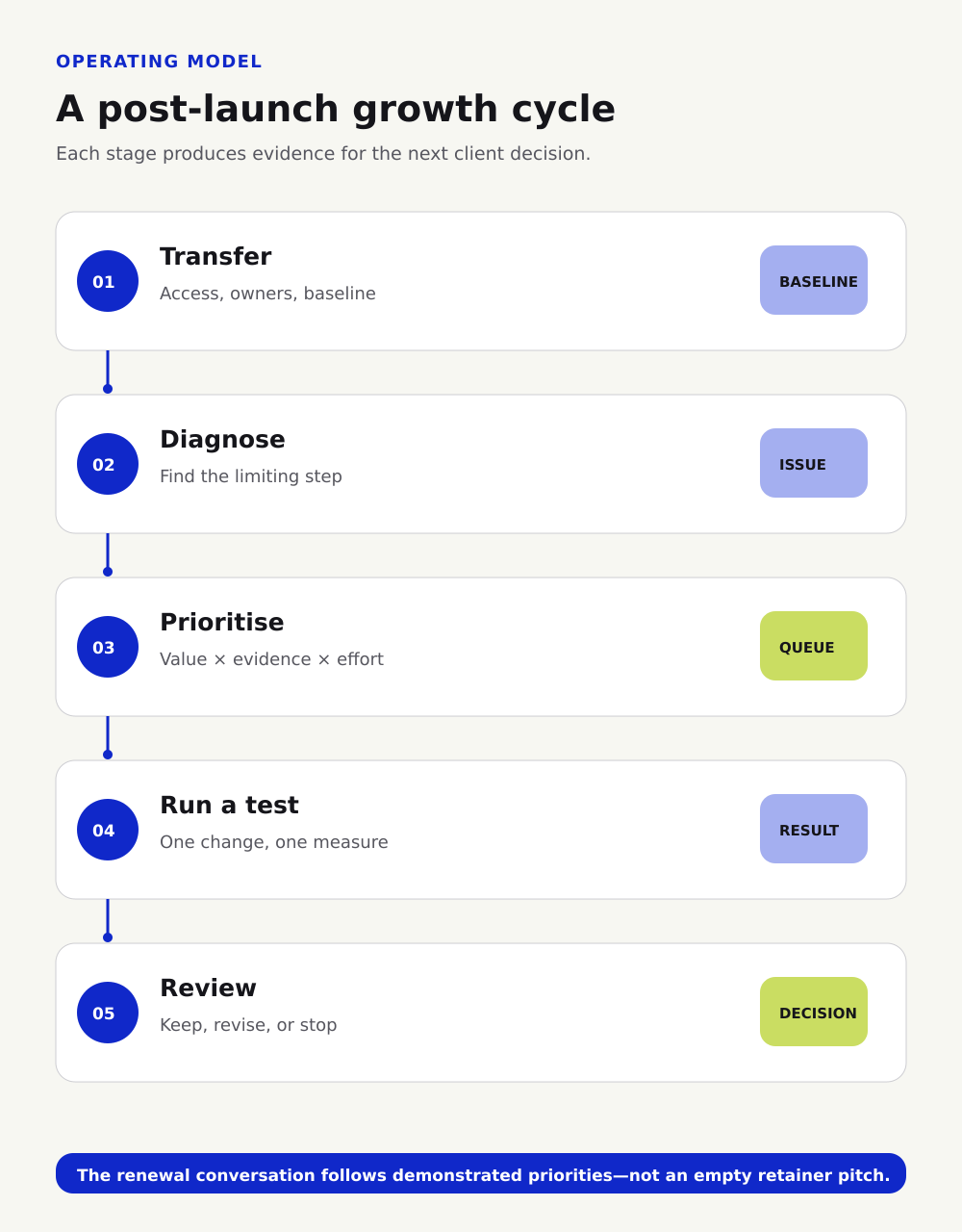
A short, scoped engagement can establish whether continued optimisation is warranted. The cadence below is an example, not a universal timeline; sales cycles, traffic volume, access delays, and client review capacity may require a different pace.
- Transfer and verify access, owners, conversion definitions, and the current site baseline.
- Review a small set of high-value journeys with the client and identify where evidence is missing or the experience breaks down.
- Choose one test with a clear audience, change, success measure, and decision rule. Record what should happen if the result is positive, negative, or inconclusive.
- Review the result alongside lead quality and operational context. Keep the change, revise it, stop it, or recommend work outside the studio’s remit.
A useful pilot produces a decision even when a test does not improve the chosen measure. The client learns what was tested, what was observed, and what should happen next.
Choose a commercial model that matches the job
Use a fixed project when the work has a bounded deliverable, such as a tracking repair or a focused conversion review. Use a paid diagnostic when the constraint is not yet clear and the client needs a prioritised backlog. A recurring optimisation engagement makes sense only when there is a real queue of work, an owner who can approve changes, and a review rhythm that can use the evidence.
Write down scope, dependencies, access, client responsibilities, reporting, and what would end or renew the engagement. Do not imply that a retainer guarantees traffic, leads, or revenue. If specialist acquisition or sales work is needed, make the handoff explicit and preserve the client’s control of accounts and data.
Report progress in the client’s language
Separate delivery measures from commercial outcomes. Page changes shipped, events validated, and tests completed show what the team did. Qualified inquiries, held meetings, accepted opportunities, and revenue show what the business observed downstream. The client may not have reliable data for every stage; mark gaps rather than filling them with platform-reported clicks or form events.
A simple monthly review can answer four questions: what changed, what evidence moved, what remains uncertain, and what decision follows? That rhythm connects the studio’s work to the client’s operating priorities. For a broader process lens, see the marketing operations maturity diagnostic and the guide to building a repeatable professional-services pipeline.
Know when not to sell the next phase
Ongoing work may be premature when the client has no accountable owner, cannot respond to new inquiries, has not validated the offer, or cannot provide enough evidence to assess the work. In those cases, the best next step may be an internal fix, a smaller measurement task, or a referral to a specialist. A disciplined handoff protects both the client relationship and the studio’s delivery capacity.
Post-launch marketing works when the studio can connect a defined client problem to a measurable next step. Start with the handoff, follow evidence through the full commercial path, and expand the relationship only when the work and ownership are clear.
How did this article land?
Choose one reaction. You can change it anytime.