

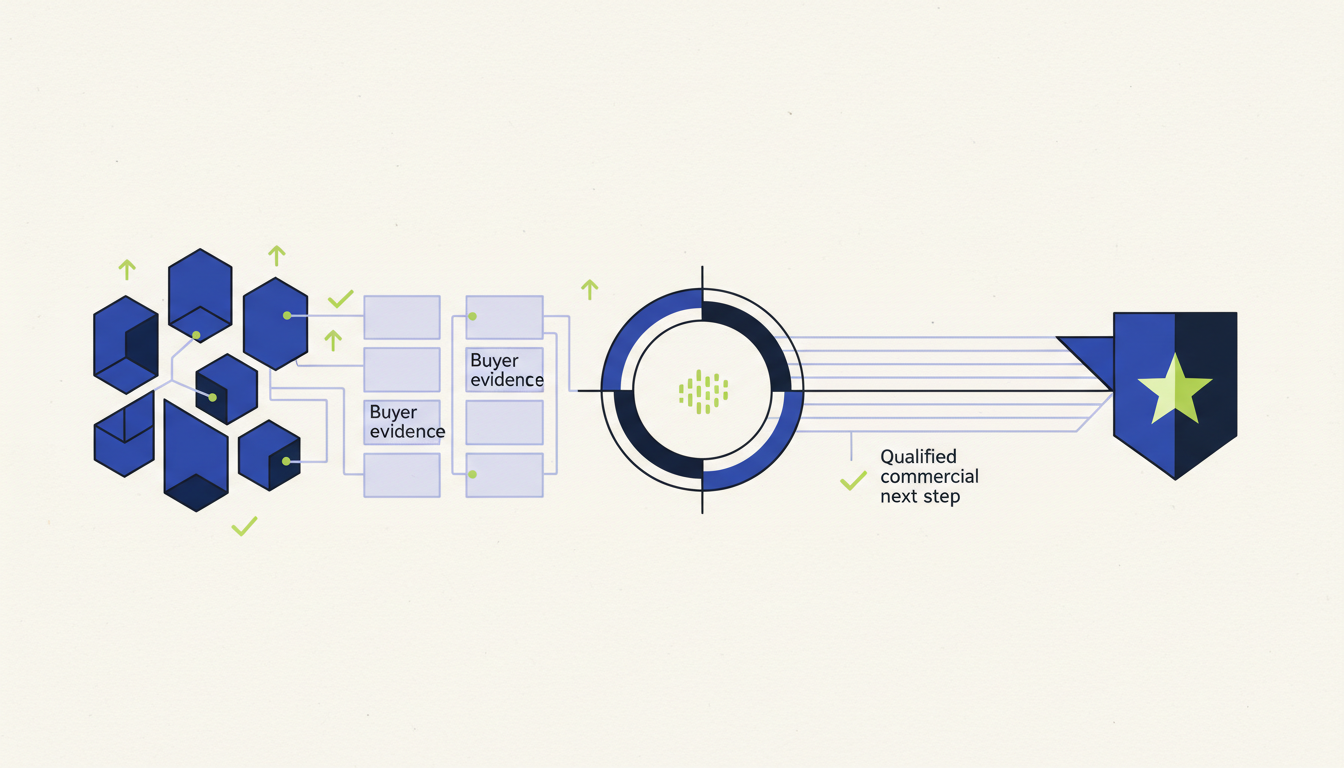
Professional services firms sell expertise applied to a client’s situation. Their marketing has to make that expertise visible before a buyer is ready to speak with a partner, while preserving enough qualification to protect delivery capacity. A strategy built around more inquiries alone can create noise: the firm may attract work that is poorly scoped, unprofitable, or outside its real capability.
This guide gives consulting, advisory, implementation, and other B2B services teams a way to connect market choice, expertise, demand, qualification, and delivery. The aim is a repeatable pipeline system that supports commercial decisions without inventing proof or promising outcomes the firm cannot control.
Choose a service line and buyer before choosing channels
Start with one service line and a clear buying situation. Define the kind of organization that can benefit, the problem that creates urgency, the people involved in choosing a provider, and the conditions that make the engagement a good fit. Include constraints such as geography, required expertise, implementation capacity, procurement requirements, or conflicts of interest where relevant.
A useful positioning statement describes the buyer’s problem, the work the firm is equipped to do, the evidence that supports its credibility, and the next step the buyer can take. It does not imply guaranteed savings, revenue, or speed unless the firm has evidence and authorization to make that claim.
Turn expertise into decision evidence
Expertise is difficult for a buyer to evaluate when it appears only as a list of services. Give the market evidence it can use: a clear point of view, a practical diagnostic, a description of the method, examples of decisions the work supports, and verified experience relevant to the service line. Keep client details confidential and obtain permission before using names, quotes, or outcomes.
Useful material helps a buyer distinguish a real business problem from a symptom and understand what a credible next step would involve. It can also disqualify a poor-fit engagement early. For example, a service page can explain prerequisites, scope boundaries, decision owners, and what information is needed for an initial conversation.
Assign each channel a job
Channels should support different buying states. Search can capture a buyer actively looking for help; thought leadership can explain an emerging issue; referrals and professional networks can transfer trust; paid campaigns can reach a defined audience or capture existing demand. Decide why a channel belongs in the plan before setting its activity target.
| Motion | Buying situation it can support | Useful evidence | Commercial signal to review |
|---|---|---|---|
| Search and practical content | A buyer is naming a problem or evaluating an approach | Clear problem explanation, decision guide, service boundaries | Qualified inquiries by service line and problem |
| Expert-led perspective | A buyer recognizes risk but has not defined the project | Original analysis, diagnostic questions, credible methods | Relevant conversations and progression into a scoped need |
| Referral and professional network | A trusted adviser can introduce the firm at a useful moment | Shared understanding of fit, introduction context, permission | Accepted introductions and qualified opportunities |
| Paid acquisition | A defined buyer group is reachable or active demand is visible | Accurate claims, a focused landing page, a measured follow-up path | Cost and quality through accepted opportunity, not clicks alone |
Keep the channel mix manageable. If the firm cannot follow up, scope, and deliver the work generated by a motion, increasing its reach may deepen the bottleneck. Review the actual path from inquiry to signed engagement in the professional services attribution guide; measurement is one input to strategy, not the strategy itself.
Design a useful first conversation
The next step should match the buyer’s level of readiness. A discovery conversation, diagnostic session, proposal request, or scoped assessment may be appropriate for different services. Make the offer clear: what the conversation covers, what preparation is useful, who should attend, and what the firm can or cannot conclude from it.
Keep intake proportional to the decision. Ask for enough context to route and prepare the conversation, but avoid making a long form the price of receiving basic information. Define acceptance criteria with the people responsible for sales and delivery, including how to handle urgent requests, unclear scope, existing clients, and work outside the firm’s service envelope.
Connect marketing records to service-line economics
Capture service line, company, problem, source, qualification outcome, opportunity stage, and next action in consistent records. Keep sourced and assisted activity distinguishable. An introduction may create access; a later search or event may help a buyer validate the choice. Avoid assigning total credit to every touch that appears in the same journey.
Review qualified opportunity creation, progression, proposals, signed engagements, sales-cycle timing, delivery capacity, and the commercial quality of the work. The right economic view depends on the firm’s model, including how it recognizes revenue and measures delivery margin. Click-through rate or form volume can diagnose a campaign, but neither establishes that the resulting work is valuable.
Run the strategy as a focused operating cycle
- Select a service line, buyer, and problem the firm can serve.
- Document proof, scope boundaries, and claims the team is permitted to make.
- Choose channels based on how buyers discover and evaluate that service.
- Agree on intake, qualification, routing, and follow-up with sales and delivery.
- Review results through accepted opportunity and signed work, then adjust one constraint at a time.
Professional services marketing becomes more repeatable when the market can understand the expertise, the buyer has a clear path to a conversation, and the firm can serve the demand it creates. Treat each channel as part of that system, and use commercial evidence to decide what to improve next.
How did this article land?
Choose one reaction. You can change it anytime.