

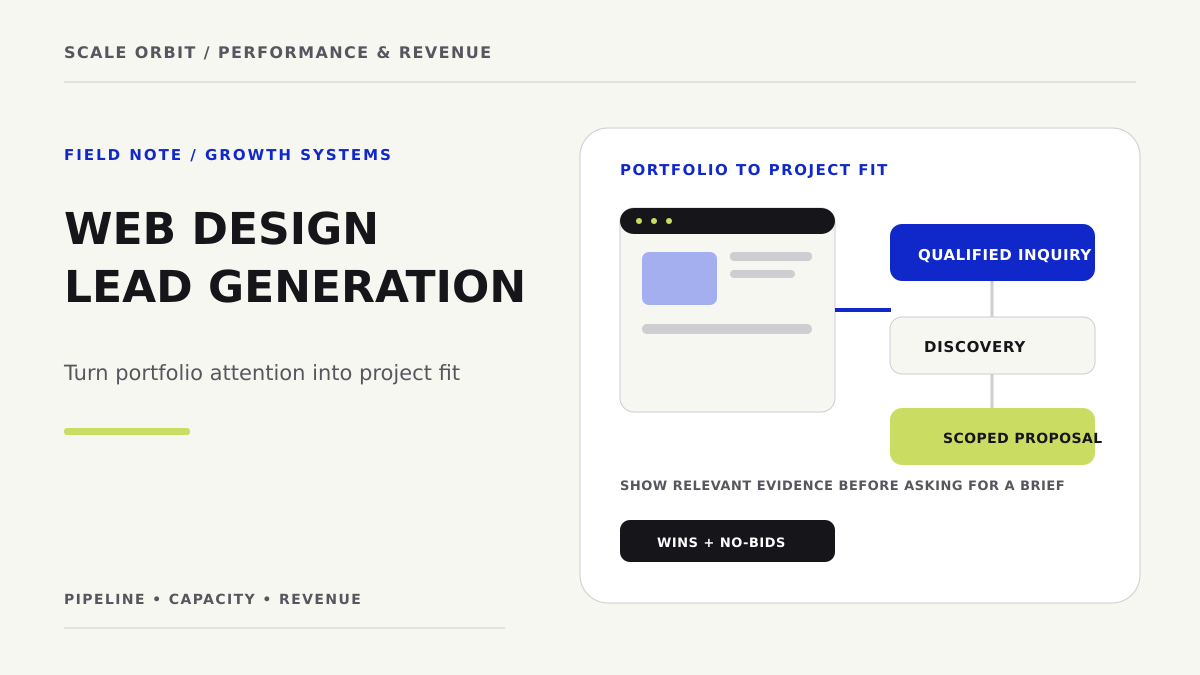
For a web design agency, more inquiries do not automatically mean a healthier pipeline. A request may be a small implementation task, a full redesign, a platform migration, or an early conversation with no shared view of scope. If every inquiry receives the same discovery effort and proposal process, the team spends scarce time resolving fit after the work has already begun.
A stronger lead-generation system helps the right buyer recognize the agency’s lane, shows evidence relevant to that buyer’s decision, and collects enough context to decide whether a deeper conversation is worthwhile.

Define a project lane buyers can recognize
A lane becomes more useful when it names a buying trigger. A new product line, a platform constraint, a fragmented service catalogue, or a planned migration gives a buyer a reason to act and lets the agency explain why its approach fits. “Beautiful websites” is a preference; a defined project trigger is a decision context.
Specialization does not have to mean serving only one industry. It can be defined by the kind of problem the agency is equipped to solve: complex service-site architecture, ecommerce rebuilds, conversion-focused redesigns, integrations, accessibility remediation, or a particular platform. Choose a lane that fits both the team’s delivery capability and the kind of project it wants to repeat.
Make the lane concrete on the site: who the work is for, what triggers the project, what is in scope, and what the buyer should expect to decide. A site structure that mirrors real search intent helps visitors find the relevant service instead of forcing every visitor through a generic agency page; see building a service-site architecture around search intent.
Turn the portfolio into decision evidence
A portfolio thumbnail shows visual work; a project narrative explains why the work is relevant. Describe the client context only where permission allows, the initial problem, the project scope, the decisions the team made, and what was delivered. If outcome metrics are included, state how they were measured and avoid attributing changes to design alone when other factors contributed.
When a client cannot be named, keep the description truthful and bounded. Do not invent a client profile, result, or before-and-after. A clear process artifact—a discovery map, content model, component system, or migration checklist—can demonstrate how the agency works without pretending to be a quantified case study.
Ask for context that changes the next step
A useful inquiry form helps route and prepare a conversation without asking prospects to write a complete brief. Separate what is needed at first contact from what belongs in discovery.
| Ask early | Clarify in discovery | Why the distinction helps |
|---|---|---|
| Project type and current site or platform, if known | Technical constraints and integration needs | Avoids an unhelpful first conversation without requiring a full audit |
| What prompted the project? | Business impact, internal owner, and affected teams | Connects the request to a decision the buyer needs to make |
| Desired timing and who is involved | Approval path, dependencies, and practical schedule | Surfaces readiness without treating an early idea as a bad lead |
| A short description of the requested outcome | Detailed scope, content, governance, and acceptance criteria | Keeps the form brief and the proposal grounded |
Investment range can be discussed when it helps both sides determine whether to continue, but it should be framed with context. A rough budget field without explanation can screen out viable work or create false certainty before scope is understood.
Use a stage model that reflects agency work
Track inquiry received, initial fit reviewed, discovery accepted, scope understood, proposal issued, decision, and project start. For each stage, define the evidence required to move forward. A proposal should be a response to a problem and scope the buyer has discussed—not a substitute for discovery.
Review time spent as well as outcomes. If many proposals stall because scope is unclear, improve discovery or qualification. If good-fit buyers do not reach the inquiry stage, revise positioning, portfolio paths, or distribution. The broader professional-services pipeline framework can help connect those stages to repeatable revenue operations.
Generate demand through proof and relevance
Useful sources can include client referrals, partner relationships, search content built around the agency’s chosen project lane, and targeted outreach where the agency has a relevant reason to contact a buyer. Each path should lead to a page or conversation that explains a specific next step. Avoid publishing a broad service list and expecting every visitor to infer why the agency is a fit.
When comparing channels, use qualified conversations and proposal progression rather than traffic alone. The cost per qualified meeting guide is one way to examine an intermediate measure; it does not replace project margin, win rate, or delivery capacity.
Protect proposal capacity and learn from no-decisions
A no-bid or referral decision can be a good outcome when the work is outside scope. Record the reason consistently: project size or type, platform mismatch, timing, budget alignment, stakeholder readiness, or available team capacity. Use those patterns to sharpen positioning and improve the first conversation.
For the next month, choose one project lane, update one portfolio path with honest decision evidence, and define the minimum information needed before discovery. Review accepted projects and declined requests with delivery leadership. The result is a pipeline that is easier to qualify and a proposal process reserved for opportunities the agency can responsibly serve.
How did this article land?
Choose one reaction. You can change it anytime.