

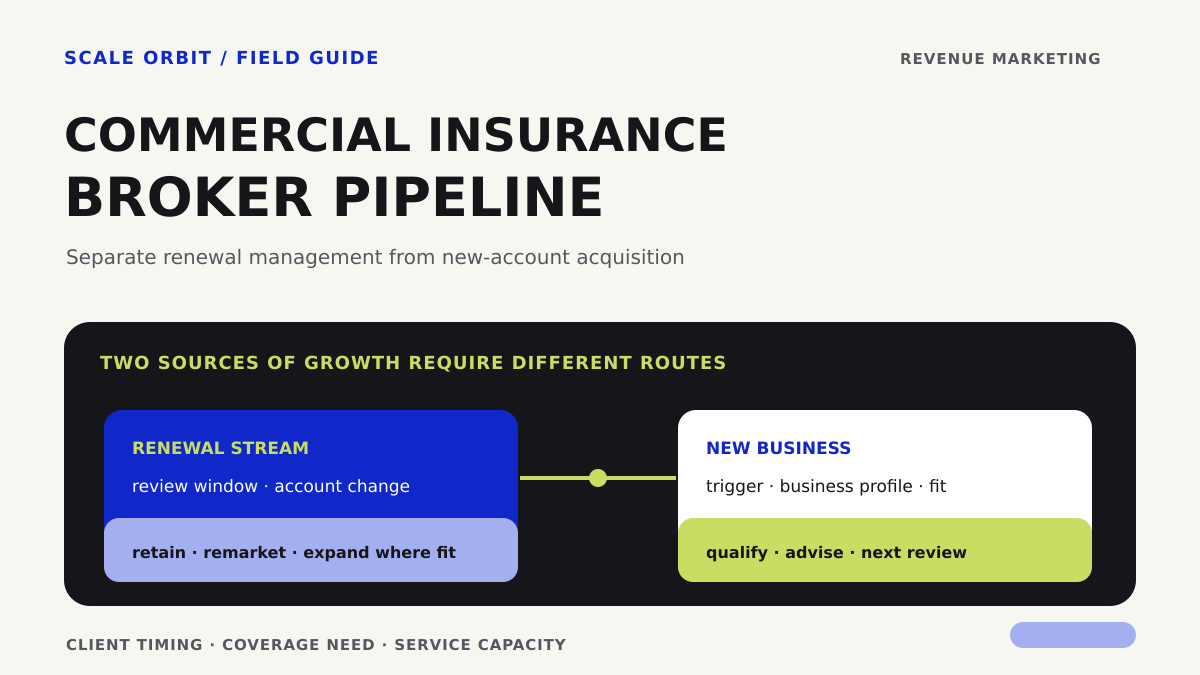
Commercial insurance brokers work two demand streams that look similar in a dashboard but behave differently. A renewal is an existing client relationship with a review window and changing business context. A new account is an acquisition opportunity that must be assessed for fit, timing, and the broker’s ability to serve it. Combining both into one generic “lead” stage obscures the work required in each.
A practical marketing system gives renewals a proactive review path and new prospects a separate qualification path, then reports outcomes in terms the brokerage can act on.

Create two routes through the pipeline
For renewals, useful signals may include the account’s agreed review date, a client-requested change, a service interaction that calls for a broker conversation, or a material business update shared by the client. The goal is to organize review and service work—not to automate a coverage recommendation.
For new business, capture the trigger for the inquiry, broad business profile, location, general service need, decision path, and timing. Let the broker determine whether the account and requested work fit the brokerage’s capabilities. Do not imply that a quote request is equivalent to a suitable or placed account.
Define different stage exits
- Renewal stream: review due → client context refreshed → broker review underway → recommendation or next service step communicated → renewal outcome recorded.
- New-account stream: inquiry received → basic fit reviewed → broker conversation → information process agreed → submission or next step accepted → quote, decline, bind, or nurture outcome recorded.
The labels should match the brokerage’s actual workflow and system. In particular, keep “quote presented,” “client decision,” and “placed business” distinct if those are separate events. A quote is a sales milestone; it is not proof that revenue has been retained or booked.
Coordinate marketing with service capacity
A campaign can produce more inquiries than the brokerage can review promptly. Before increasing spend, agree on who owns first response, what information is appropriate to collect, how inquiries are assigned, and when the account team should be involved. For renewals, configure review timing around the brokerage’s process, client commitments, and relevant requirements; there is no single calendar that fits every account.
In the CRM, keep the minimum useful context visible: stream type, account or prospect, assigned broker, relevant review or decision date, source, next action, and outcome. Avoid placing sensitive client documents or detailed coverage information in a marketing form or unapproved system.
Report each stream on its own
For new business, examine fit-reviewed inquiries, broker conversations held, opportunities accepted, quotes or proposals where applicable, and placed outcomes. For renewals, examine review completion, client decisions, retained accounts, and appropriate account changes. Add response time and workload measures so a change in conversion is not mistaken for better performance when the team is simply unable to follow up.
Attribution deserves care. Referrals, long-standing relationships, service interactions, and paid media may all contribute to an account decision. Preserve the original source and the broker’s notes about later influence instead of assigning all credit to a final form or call.
Improve the weakest handoff first
Review a recent set of new inquiries and renewals separately. Find where records stalled: no owner, missing context, delayed response, unclear review timing, or a next step the client did not understand. Fix that handoff before adding more top-of-funnel activity. The professional services pipeline model can help align marketing and sales definitions, while the qualified conversations article covers why inquiry volume alone is a weak success measure.
For commercial brokers, predictable marketing starts with operational clarity: distinguish renewal work from acquisition, route each to an owner, and judge the system by the next meaningful client decision—not by clicks or quote requests alone.
How did this article land?
Choose one reaction. You can change it anytime.