

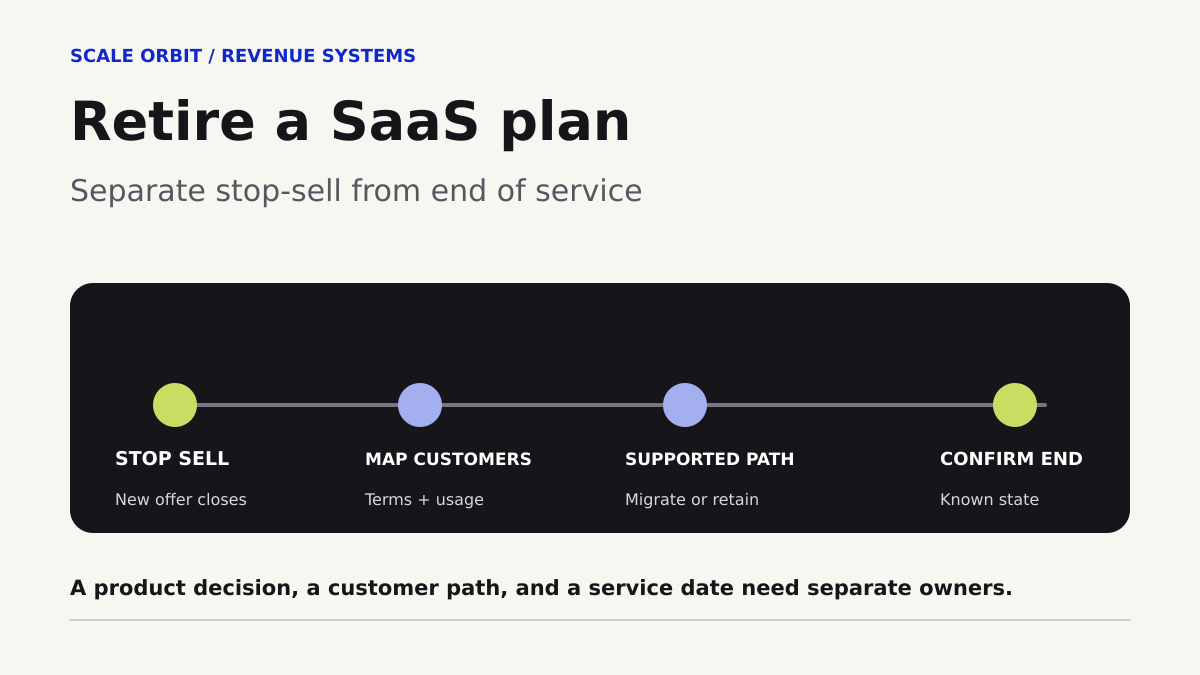
A SaaS plan sunset can mean several different things: stop selling a tier to new buyers, stop supporting a feature, move current customers to another plan, or discontinue a service. Treat these as separate decisions. Closing a plan to new sales does not by itself define what happens to active customers or what their agreements require.
A clear sunset plan names the product boundary, affected accounts, customer options, decision owners, and the evidence needed to confirm that the transition is complete. Without those elements, customers can be left unsure whether their access, renewal, or support is changing.

State exactly what is ending
Describe whether the change affects new purchases, renewals, a product capability, or service availability. Identify the reason for the sunset in business terms: product focus, duplicated capability, support burden, or a commercial model the company can no longer maintain. Keep the rationale factual and avoid implying that a discontinued tier was a poor choice for customers who selected it.
Set a boundary for the decision. A stop-sell may leave current customers on their existing terms. A plan migration changes the customer’s destination and needs an account-level mapping. An end-of-service decision carries different continuity and contract questions and should receive its own review.
Map affected customers before announcing
Build a list from subscription, product-access, billing, and CRM records. For each account, capture the plan, active contract, renewal timing, capabilities in use, integrations, operational dependencies, service owner, and any prior exception. Reconcile mismatched records before sending notices; a list built from plan names alone can miss customers with custom entitlements.
Offer a customer path with a real owner
- Explain the change: name the exact plan or capability affected and distinguish what continues from what ends.
- Show the available path: provide the replacement option, a supported migration route, or a clear way to discuss an exception.
- Give timing and contact: state relevant dates and identify the person or team responsible for questions.
- Prepare the receiving teams: equip customer success, support, sales, billing, and product with the same account-level guidance.
Do not create urgency with a date the company cannot operationally meet. Align the customer timeline with actual contract review, product readiness, data handling, and support capacity. The customer-success plan template can help make the account owner and next action explicit.
Manage exceptions as a finite queue
Some accounts may need additional time because of a contract, integration dependency, or documented service requirement. Record the reason, accountable approver, agreed path, and next review date. An exception without an owner or expiry can quietly become a second legacy program that is harder to support than the tier being retired.
Define what completion looks like
For a stop-sell, completion may mean future offers and sales materials are updated while active agreements remain intact. For a migration, completion requires a verified customer state and a resolved billing and access record. For a service end, completion may require a separate continuity plan and a clear status for every affected account.
Keep three internal dates distinct: the date new purchases stop, the date affected customers must choose a path, and any date on which a capability or service would actually end. Each date needs its own owner and readiness check. A sales-page update can close the offer to new buyers while leaving an active customer path unchanged; a product shutdown cannot be treated as the same administrative task.
Track customers notified, transition choices, unresolved questions, support issues, billing corrections, renewal outcomes, and accounts that remain on exceptions. Review those signals with a customer-level outcome, not just a count of emails sent. A renewal review pack provides a related way to keep verified outcomes and open risks visible.
A responsible sunset ends with a known state for each affected customer and a retired offer that the company no longer has to explain inconsistently. Decide separately what stops, when it stops, and who remains accountable until the last transition is complete.
How did this article land?
Choose one reaction. You can change it anytime.