

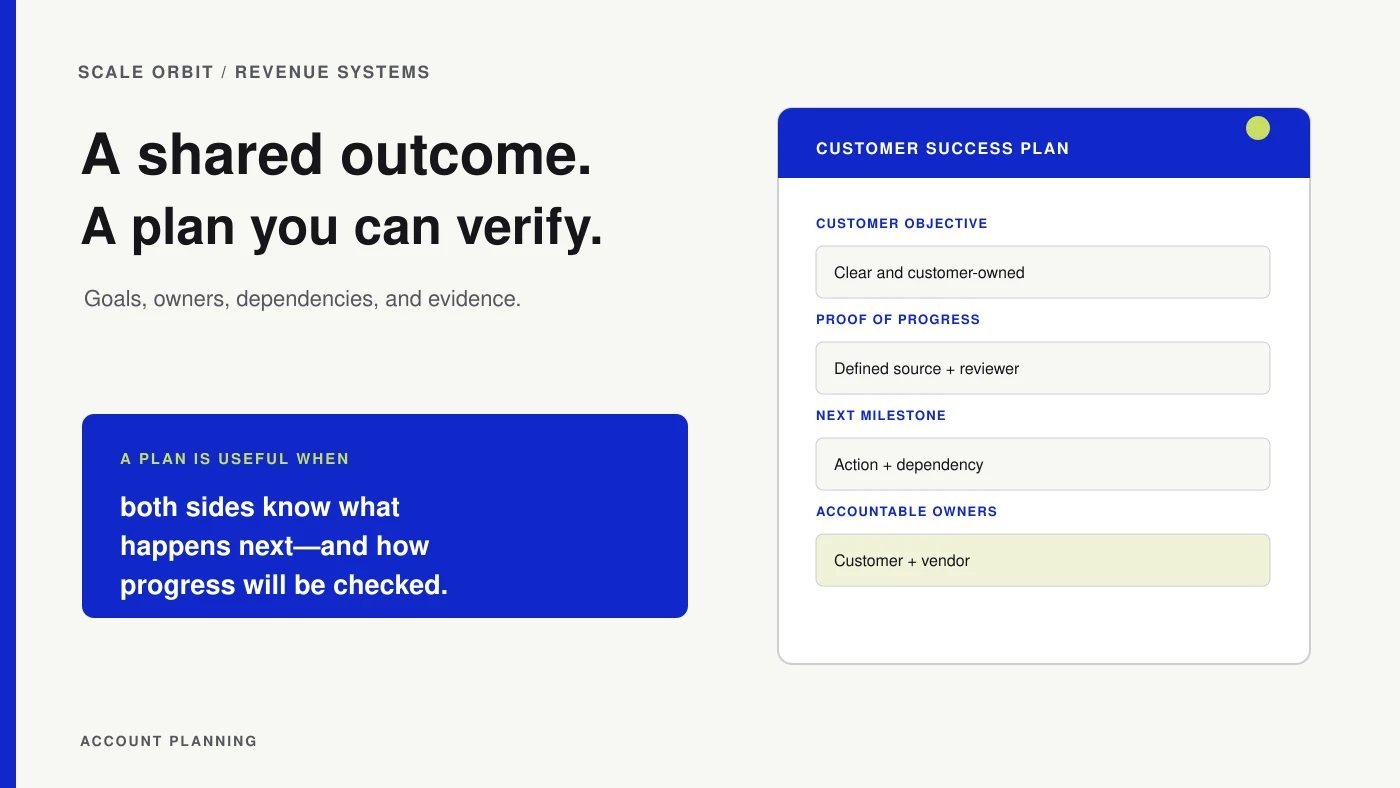
A customer success plan is a working agreement for a specific account. It records the outcome the customer wants, how both sides will recognize progress, who owns the next actions, and what could block the work.
It is not a promise that the vendor can control the customer’s business result. It is also not the same as an onboarding checklist, product usage report, or internal account-health score. A useful plan connects the customer’s objective to observable evidence and a shared sequence of actions.
Start with the customer outcome
Ask the customer to describe the business change they want and why it matters now. Translate the answer into language both sides can recognize. “Improve adoption” is too vague by itself. Clarify which users, workflow, or decision should change and what evidence would make the change meaningful.
Separate the desired outcome from the product activity that may support it. A login, training session, or feature activation can be a useful milestone, but it is not automatically proof that the customer’s goal has been reached.
Use this account-level plan template
| Plan field | What to record |
|---|---|
| Customer objective | The customer’s intended business or operational change, in their language |
| Current state | The baseline, process, or limitation as currently understood |
| Evidence of progress | The observable indicator, its definition, source, and reviewer |
| Actions and milestones | The work required, sequence, dependencies, and target dates |
| Customer owner | The person or team accountable for customer-side actions |
| Vendor owner | The person or team accountable for delivery, enablement, or support |
| Assumptions and risks | Conditions that may change the plan or prevent progress |
| Decision date | When the parties will review evidence and choose the next action |
Do not fill unknown fields with guesses. Mark assumptions clearly and name the person who can verify them. If there is no reliable baseline, agree how to establish one before making a claim about improvement.

Build the plan in six steps
1. Confirm the objective and scope
Ask which business process or user group is in scope, who needs to benefit, and what is explicitly out of scope. Confirm that the people in the conversation can validate the objective or identify who should.
2. Agree on evidence
Choose a small number of indicators that can be interpreted consistently. For each, define the source, time period, eligible population, and owner. Separate leading evidence—such as completion of a required setup—from lagging evidence, such as a business result that may have several causes.
The measures should support a decision, not decorate a quarterly review. The guide to customer success metrics explains why leading and lagging signals answer different questions.
3. Sequence actions around dependencies
Put actions in an order that reflects what must happen first. A user training session may depend on access being configured; a usage review may depend on the right users being identified. Give every action one accountable owner and a date or condition. Avoid a list of activities with no link to the customer’s goal.
4. Name assumptions and risks
Record issues that could change the plan: access delays, missing data, staffing, integration work, internal approvals, product limitations, or a change in business priority. Distinguish a confirmed blocker from a possible risk and assign someone to verify each one.
5. Review decisions, not just status
Set a review cadence around meaningful milestones and decision points. At each review, confirm evidence, identify changed assumptions, resolve ownership gaps, and agree on the next action. If a plan is unchanged, the review should still verify whether the objective remains important.
6. Revise with a visible history
When the customer changes the goal or a dependency shifts, record what changed, who agreed, and why. Do not quietly replace a target or date and later present the new version as the original plan.
A clearly illustrative example
Suppose a software customer wants a regional service team to use a new case workflow. The plan might name the relevant team, document the current process with the customer’s permission, define the workflow completion evidence, assign configuration and training owners, and schedule a review after the team has had a chance to use it.
That example does not imply a result or timeline. The customer’s staffing, data, process, and product configuration determine what is feasible. A plan should expose those dependencies rather than imply that implementation alone guarantees an operational outcome.
Keep the plan distinct from nearby documents
An onboarding plan sequences setup and early use. A customer success plan connects account goals, evidence, owners, risks, and decisions across the relationship. A health score summarizes selected signals; it does not replace the conversation or prove the customer is on track. Customer education, product adoption, renewal planning, and support records may all contribute evidence, but they serve different jobs.
When a sales commitment becomes a delivery dependency, transfer it with context and a named owner. The article on moving sales commitments into a customer delivery handoff covers that transition. For onboarding specifically, see customer onboarding stages and goals.
Signs the plan needs repair
Rework the plan if it is mostly a list of vendor tasks, uses metrics the customer cannot interpret, has no customer-side owner, treats activity as an outcome, or carries forward stale assumptions. A long plan is not automatically a thorough plan. Keep only the information needed to coordinate work and make the next decision.
The first useful step is to review one active account with the customer and fill the template together. If the team cannot agree on the objective, evidence, or owner, resolve that gap before adding more status fields or automations.
How did this article land?
Choose one reaction. You can change it anytime.