

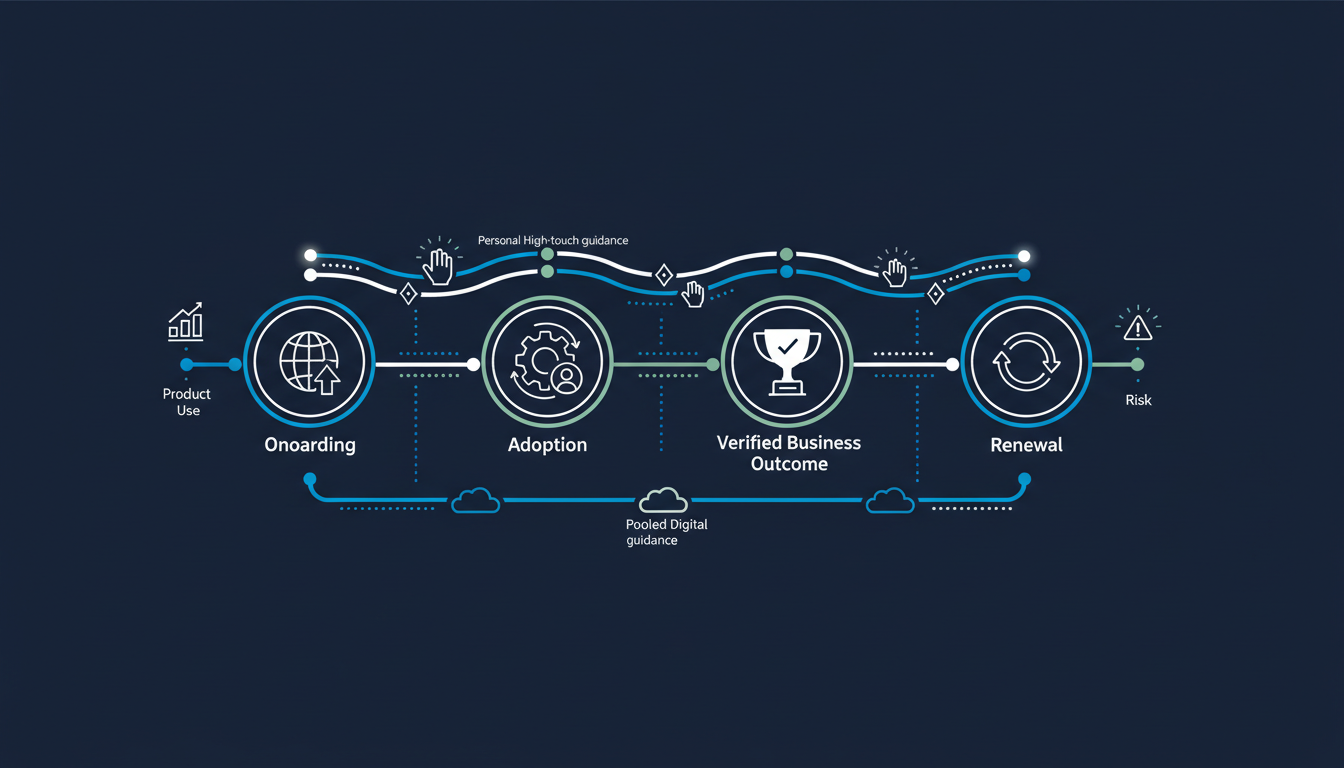
A useful customer success team structure starts with the customer outcome the function is accountable for, then assigns coverage and decision rights to match the work. There is no universal CSM-to-account ratio: implementation complexity, customer goals, product risk, and the amount of human guidance required all change the design.
Use this guide to choose a charter, segment customers by service need, define role boundaries, and add capacity when evidence shows a real bottleneck. The goal is an operating model that makes ownership clear from onboarding through adoption, renewal, and expansion.
Set the charter before choosing a hierarchy
A customer success team can be asked to improve adoption, protect retention, or identify appropriate expansion. Those outcomes overlap, but they create different priorities. The Technology & Services Industry Association describes these as distinct customer success charters; decide which one leads in your company before setting roles or targets.
| Primary charter | The customer commitment | Useful operating evidence |
|---|---|---|
| Adoption | Help customers reach a defined outcome with the product or service. | Time to an agreed value milestone; progress by onboarding cohort; meaningful use tied to the customer goal. |
| Retention | Make realized value and renewal readiness visible early enough to act. | Risk reasons, unresolved outcome gaps, renewal readiness, and retention by customer cohort. |
| Expansion | Identify when additional products, seats, or services can advance a customer goal. | Evidence of unmet needs, value already achieved, and qualified opportunities with a clear commercial owner. |
Choose a primary charter and name the others as shared or secondary outcomes. If every CSM is simultaneously measured on adoption, renewals, expansion, product feedback, ticket deflection, and relationship health, the job turns into a queue of competing requests. A clear charter makes trade-offs explainable.
For more background, read the TSIA guide to customer success charters.
Segment customers by the service they need
Revenue is one input to coverage, but it is not a complete service design. A high-value account can have a simple, repeatable implementation; a smaller account can require unusual technical work or carry a risk that needs direct attention. Evaluate the work and customer context together:
- Implementation effort and time to first meaningful value.
- Number of products, integrations, teams, or workflows involved.
- Importance and urgency of the customer’s stated business outcomes.
- Need for technical coordination, executive alignment, or change management.
- Renewal risk, expansion potential, and the cost of an avoidable service failure.
- How much of the interaction can be reliably handled through product guidance, community, or digital programs.
Then place accounts on two practical dimensions: how much expert judgment is needed and how repeatable the work is. This prevents an ARR-only rule from assigning every customer in a revenue band the same experience. Gainsight’s current team-design guidance similarly discusses combining high-touch and digital coverage, using segmentation to match engagement to customer context; treat its examples as options to test, not fixed benchmarks.

| Customer work pattern | Possible coverage | Design check |
|---|---|---|
| Complex rollout, multiple stakeholders, high consequence of delay | Named CSM with implementation or technical support at defined milestones. | Is the named owner accountable for the outcome plan, even when a specialist performs part of the work? |
| Repeatable adoption path and moderate support needs | Pooled CSM coverage, scheduled programs, and event-based follow-up. | Can customers still reach a person when an adoption or risk signal crosses the agreed threshold? |
| Large long-tail segment with a stable product journey | Digital onboarding, education, community, and triggered human intervention. | Are digital messages based on product and customer context, with an escalation route for exceptions? |
Use the existing pooled-versus-named coverage guide for a deeper comparison of service models. The broader structure decision is whether the team should be centralized, aligned to product lines, or organized around shared services such as onboarding and education. Centralization can preserve one method and shared insight; embedded roles can shorten the path to product decisions when product lines differ substantially. A hybrid model may work once each side has clear decision rights. Gainsight describes centralized, embedded, and community-hub structures as options that evolve with the business.
Assign each kind of customer work to an owner
A customer success team is not simply a group of CSMs. The work often needs a small set of distinct capabilities. One person can hold several roles in a small company, but the owner and handoff should still be explicit.
| Capability | Accountable work | Boundary to document |
|---|---|---|
| Customer success manager | Outcome plan, adoption follow-through, risk coordination, and relationship context. | Does not become the default owner of every support ticket or every commercial negotiation. |
| Implementation or onboarding | Technical setup, launch milestones, training, and time-to-value dependencies. | Define when onboarding ends and who owns the next success milestone. |
| Technical account or success specialist | Complex integrations, architecture questions, and technical risk that repeat across accounts. | Route product defects to engineering with evidence; do not promise roadmap dates. |
| Renewals or account executive | Commercial terms, procurement, and expansion negotiation where those sit with Sales. | CS supplies outcome evidence and customer context; Sales owns the commercial commitment. |
| Customer success operations | Segmentation rules, lifecycle data, playbooks, capacity, and reporting. | Build a useful system for customer-facing work rather than reporting for its own sake. |
This ownership map also protects the relationship with Support: Support resolves incoming product or service issues; Customer Success coordinates progress toward customer outcomes. For the sales side of a CSM role, see the CSM hiring scorecard and the capacity model for customer success managers.
Add roles when repeated work proves the need
Hire against a recurring constraint, not an impressive-looking org chart. Before opening a role, identify the work, show its frequency, and test whether a process, product change, or better knowledge resource would solve it first.
| Repeated signal | Possible next capability | Evidence to check |
|---|---|---|
| Customer goals are lost during setup or time-to-value varies widely. | Dedicated onboarding or implementation ownership. | Compare milestones, delays, and rework across recent onboarding cohorts. |
| CSMs spend most of their week on routine questions and escalations. | Support workflow improvements, clearer knowledge, or a specialist support role. | Review issue categories, repeated contacts, transfers, and CSM time spent outside the success plan. |
| Customers need recurring technical coordination across products. | Technical account management or a customer success engineer. | Confirm the same expertise is needed across enough accounts to support a defined role. |
| Segmentation and customer records differ by manager or spreadsheet. | Customer success operations. | Measure how often manual data work delays customer action or makes reporting unreliable. |
| Renewal work is crowding out adoption or commercial process is inconsistent. | A renewal owner or clearer Sales-CS division of work. | Inspect renewal volume, procurement effort, forecast misses, and customer experience by segment. |
If account load is the concern, use a workload model that includes customer complexity, meeting cadence, onboarding, and non-customer-facing work. A single “accounts per CSM” benchmark hides these differences. See the customer QBR agenda for one example of turning customer context into a decision-focused meeting.
Launch the model in 90 days
- Days 1–30: establish the facts. Review the customer journey, onboarding outcomes, renewal risks, support themes, and CSM workload. Interview customer-facing teams and select one primary charter.
- Days 31–60: define the service map. Segment by service need, set ownership for onboarding, support, success, and commercial decisions, then write the handoff rules and escalation signals.
- Days 61–90: pilot one segment. Run the new coverage model with a bounded customer group. Compare outcome progress, time spent, customer friction, and unresolved work with the prior baseline before expanding it.
The 90-day sequence is a planning approach, not a promised transformation timeline. If the customer journey is disconnected from acquisition data or CRM ownership, connect the segment and outcome definitions to the broader revenue system before asking the CSM team to compensate manually.
Measure customer outcomes and the work behind them
Review results by segment and customer cohort. Combine leading signals such as onboarding milestone completion and product adoption tied to a customer goal with lagging outcomes such as renewal or expansion. Track service experience and effort as well, so an apparent efficiency gain does not simply move work onto the customer.
Do not credit Customer Success alone for every change in retention or expansion. Product reliability, pricing, Sales, support, and customer conditions also matter. The useful question is whether the team’s work improved the customer’s path to value and made risk visible early enough for the right owner to act.
Connect the model to revenue visibility
Customer Success can reveal where the promise made during acquisition fails to match activation or ongoing use. If your team cannot connect source, segment, and customer outcome evidence across the CRM, talk with Scale Orbit about the measurement and handoff problem.
Further reading
- A Brief Guide to Customer Success — TSIA.
- Customer Success Team Structure: The Ultimate Guide — Gainsight.
How did this article land?
Choose one reaction. You can change it anytime.