

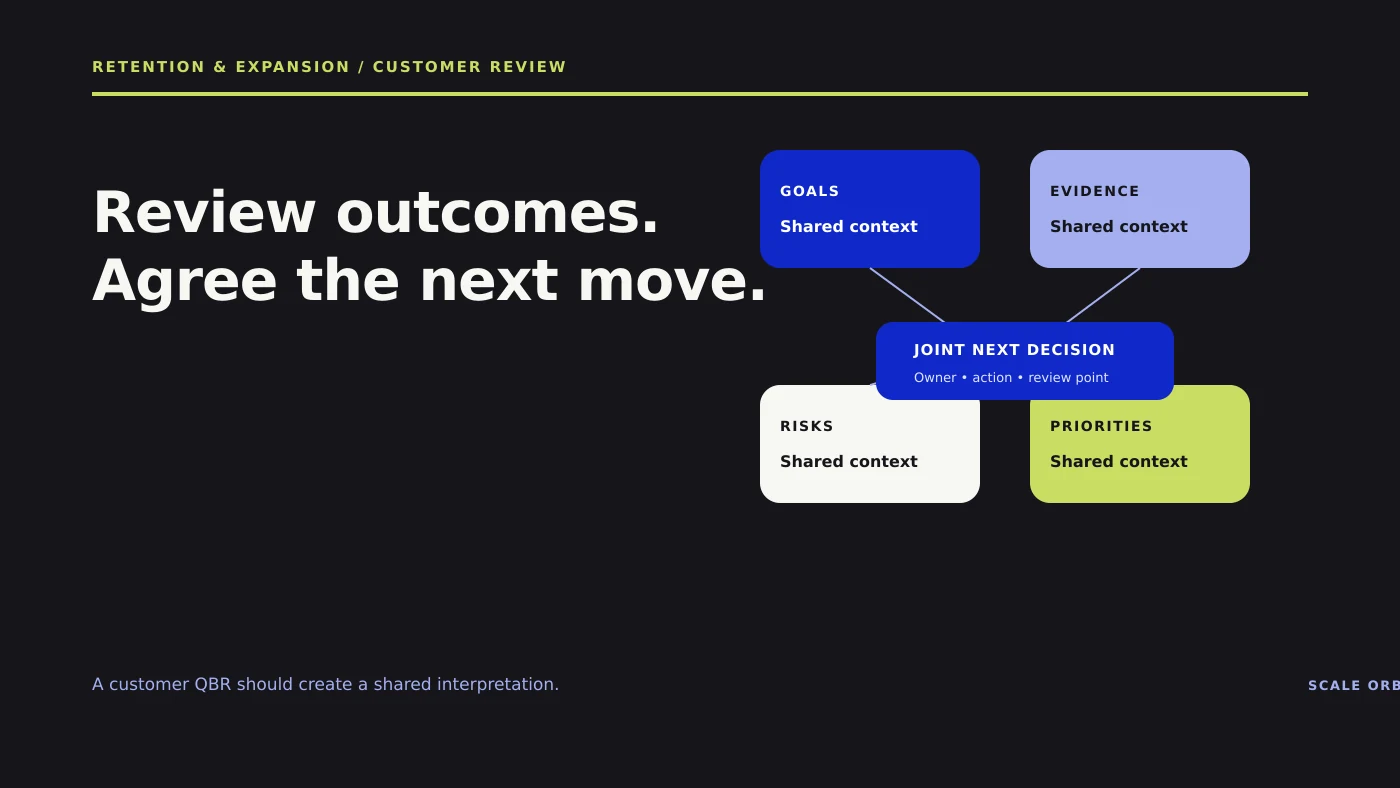
A useful customer QBR—quarterly business review—is a structured conversation about the outcomes the customer expected, the evidence available, what is changing, and which decisions or actions should follow. The meeting should help both sides make progress on the customer’s business priorities. A stack of usage charts or a vendor performance presentation is not enough.
Quarterly is a common rhythm, but it is not automatically the right interval. Use a cadence that matches the customer’s operating cycle, the pace of change, and the decisions that need shared attention. For some accounts, a shorter working review and a less frequent executive review may be more useful than one large meeting.
Prepare from the customer’s goals
Start with the outcomes and scope in the current customer success plan. Confirm what the customer said mattered, which measure or operational evidence can show progress, and what has changed since the last review. Separate verified results from interpretation and open questions.
Before the meeting, ask the customer what has changed in its priorities, operating context, and stakeholder group. Confirm who needs to attend and what they should be able to decide. A senior sponsor may be useful when strategic direction or resourcing is on the agenda; a day-to-day operator may be essential when workflow detail needs review.

Use an agenda that leads to shared action
| Agenda section | Questions to answer | Meeting output |
|---|---|---|
| Customer priorities | What matters now, and has the original goal changed? | Confirmed priority and decision context |
| Outcome evidence | What changed, how was it measured, and what is still uncertain? | Agreed reading of progress and limits |
| Adoption and workflow | Where is the solution part of real work, and where is friction visible? | One or two specific obstacles to address |
| Risks and dependencies | What could prevent the next outcome, and who controls each dependency? | Named owner and escalation route |
| Next value and decision | Which action is worth taking next, and what would make it successful? | Shared action plan with owner and review point |
This is an adaptable structure, not a script. Allocate time based on the decisions required. If the customer has no new strategic question, a working session on one unresolved obstacle may be more valuable than a formal presentation.
Present evidence with its limitations
Show the time period, data source, definition, and relevant comparison for each important measure. Explain when the data is incomplete or affected by seasonality, changes in user eligibility, instrumentation, or a different denominator. The guide to leading and lagging customer-success indicators can help the team distinguish early signals from outcomes. Avoid presenting a rise in logins or page views as proof of customer business impact unless the customer has agreed that the measure supports that conclusion.
Use a simple story: the customer’s stated objective, what the evidence shows, what it does not show, and which decision follows. Let the customer correct the interpretation. The review is a two-way operating conversation; the vendor should not assume that its dashboard captures the customer’s full outcome.
Keep the customer meeting distinct from internal preparation
Prepare internally before inviting the customer into the discussion. Align on verified results, open risks, owners, and any proposed change in scope. Do not use the meeting to discover an internal disagreement about delivery or commercial terms.
The internal renewal review pack helps teams organize renewal evidence and risks; the customer-facing QBR uses that preparation to have a focused discussion. A shared customer success plan is the place to maintain goals, actions, owners, and review points after the meeting.
Close with a decision record
At the end, recap:
- What the customer confirmed or corrected.
- Which action each side accepted, with a named owner.
- What remains open and what evidence would resolve it.
- Any change in the customer’s goal, stakeholder, or decision timing.
- When the group will review progress again.
Send the summary promptly and make sure it reflects the customer’s language. Update the shared plan and internal account record so the next team member can understand what was agreed.
Know when a QBR is not the right meeting
Do not schedule a large review when the account needs an urgent support response, a narrow technical working session, or a commercial decision with its own process. Route those needs to the appropriate owner and use the QBR to examine the broader outcome once the immediate issue is contained.
Review the format after several cycles. Keep sections that lead to useful customer decisions, remove slides that repeat without changing the discussion, and adjust the participants to the work. The measure of a good QBR is whether both sides leave with a more accurate view of progress and a clear next action.
How did this article land?
Choose one reaction. You can change it anytime.