

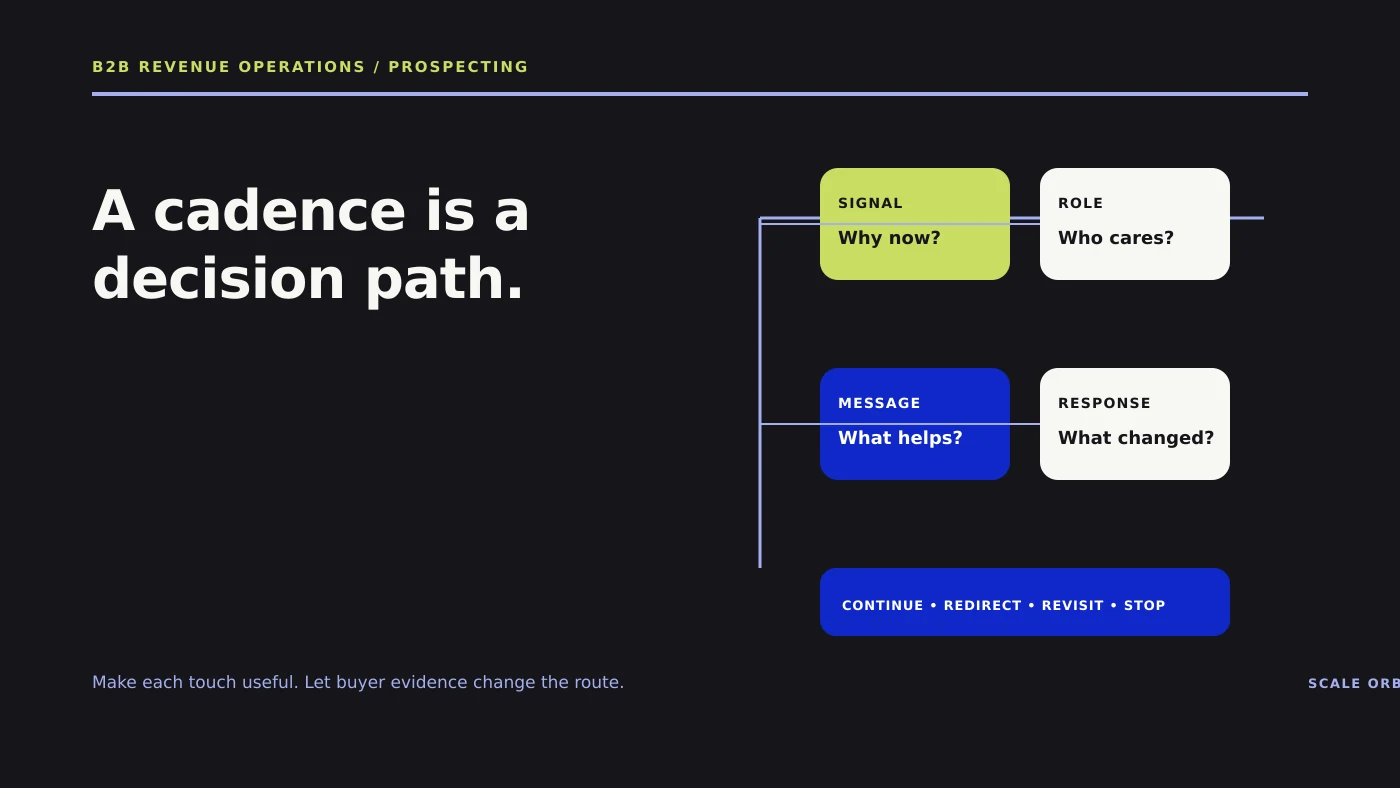
A B2B sales cadence is a planned series of useful attempts to reach a buyer or buying group. It should give a seller a clear reason for each contact, make different channels serve different jobs, and stop when the buyer’s response or account status changes. A cadence is not a fixed number of touches that every prospect must receive.
The purpose is to create a relevant conversation or learn that the account is not ready, reachable, or a fit. Activity counts can show that work happened; they do not show that the buyer had a reason to engage or that a qualified opportunity exists.
Start with an account signal and a testable reason
Before selecting contacts, write down what makes the account relevant now. It could be a public business change, a role-specific challenge, a request, or a known operational constraint. Distinguish observed evidence from your hypothesis. “The company is expanding into two regions” may be observed; “its lead routing is failing” is an assumption until confirmed.
Then define one useful reason to contact:
- Which role is likely to own the problem or recognize it?
- What business issue may be affected?
- What small next step would help the buyer test whether the issue matters?
- What evidence would cause the seller to change the message or stop?
If the only reason is that the contact matches a broad list, the cadence is not ready.
Give each touch a distinct job
A multi-channel plan works when the channel changes the way the seller learns or helps. Repeating the same pitch through email, phone, and social messages adds volume without adding a new reason to respond.
| Touch | Job | Useful evidence to capture |
|---|---|---|
| Initial email | Connect a verified observation to one relevant business question | Reply, correction, referral, or no response |
| Call or voicemail | Test whether the role or timing is right and make redirection easy | Reachability, role confirmation, requested follow-up |
| Follow-up note | Add a concrete clarification, comparison, or resource tied to the original hypothesis | New question, objection, or confirmation |
| Professional social interaction | Build context when a genuine, relevant interaction is available | Public business signal or direct response |
| Close-the-loop message | Summarize the reason for contact and make it easy to pause or redirect | Continue, revisit at a named time, or stop |

This table describes possible functions, not a required order or interval. Use channels only when the contact information, company policy, and applicable rules allow the outreach. If an account is better served by one thoughtful introduction, a multi-touch sequence may add no value.
Set timing from the reason and buyer context
Choose spacing that gives the person time to read, reply, or route the request. A cadence triggered by an explicit inquiry may need a prompt human response. A cold account research hypothesis deserves more room between touches. Buying complexity, time zones, workload, channel norms, and the importance of the question all affect timing.
Avoid a universal “best cadence” claim. Start with an operating hypothesis, document why it fits this audience, and compare results within similar segments. A sequence for an executive at a large account may not be comparable with one for a small business owner or a technical evaluator.
Define stop and change rules before launch
A useful cadence has exit conditions. Stop or move the record when:
- The person replies, asks for information, redirects the seller, or books a meeting.
- The contact opts out or the organization’s suppression rule applies.
- New evidence shows the account is not a fit or the original trigger is no longer current.
- The seller confirms an active opportunity that needs coordinated follow-up instead.
- Contact information is incorrect, or the role has changed.
If timing is the only barrier, record a revisit condition rather than restarting the same sequence automatically. If the buyer is engaged, shift from scripted touches to a conversation shaped by what they said.
Keep the CRM record useful
Record the account, contact role, reason for outreach, relevant source, cadence version, response, and next action. Use CRM activity to preserve context; use qualified opportunity fields only when the buyer evidence meets the team’s criteria. Do not convert an email open, click, or unanswered call into buying intent.
The sales engagement platform and CRM guide covers system ownership when outreach is coordinated across tools. The B2B sales playbook can store the approved reasoning and boundaries behind recurring plays. For a conversation that has already happened, the sales call follow-up templates address the separate task of confirming what was heard and agreed.
Review for learning, not just completion
Review a cadence by audience, account fit, trigger, message, channel, and downstream outcome. Ask whether people responded, whether the right roles engaged, what reasons they gave, and whether accepted conversations became qualified opportunities under the same definition.
If response is weak, do not simply add more touches. Check whether the trigger is real, the target role can act, the message names a business issue, or the channel is appropriate. A good cadence makes the seller more relevant and the operating system more informative, even when the evidence says to stop.
How did this article land?
Choose one reaction. You can change it anytime.