

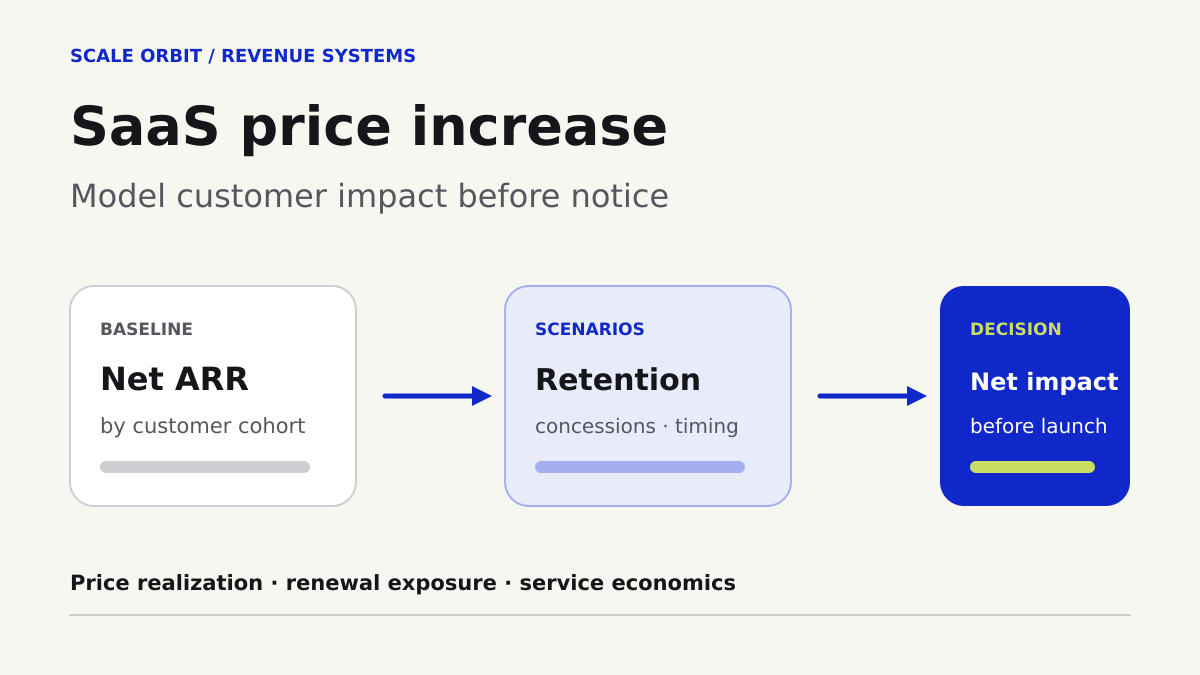
A SaaS price increase is a change to the economics of customer relationships, not simply a percentage added to a list price. The outcome depends on which accounts are eligible, when their contracts renew, what they actually pay after discounts, and how customers respond. A useful decision model makes those effects visible before the first notice is sent.
Start by separating three questions: Is the current price sustainable? Which customer groups can be affected under their agreements? What change in realized revenue and contribution is acceptable given retention and service risk? Keeping those questions separate prevents a proposed list price from being mistaken for a forecast.

Build a baseline by customer cohort
Do not begin with one average contract value. Group accounts by variables that change the decision: product plan, contract term, renewal window, discount, usage pattern, geography, customer tenure, and support effort. Use only dimensions the company can identify consistently in billing, CRM, and product records.
For each cohort, record current net recurring contract value, active account count, renewal timing, recent contraction or churn, and material service costs. Keep annual and monthly contracts distinct where their terms or renewal behavior differ. Reconcile the commercial record to billing evidence; a CRM amount may reflect an outdated quote rather than the current net price.
Model the price customers will actually realize
A simple cohort model is more useful than a single headline uplift. For each group, estimate eligible accounts, expected retained share, new net contract value after concessions, and the date the new amount could take effect. Then compare expected recurring revenue with a same-period baseline. Show service costs, credits, and implementation effort separately so a higher ARR estimate is not confused with higher contribution.
Build at least three views: the planned change, a lower-realization case with more concessions or delayed renewals, and a no-change baseline. State the assumptions beside each view. If the model requires an unobserved churn response, mark it as a hypothesis and show how the decision changes when that assumption moves.
Keep revenue decomposition precise. The price-volume-mix analysis can help separate a price effect from a shift in customer or product mix. Neither analysis by itself proves why a particular account renewed or left.
Set guardrails before choosing an effective date
- Contract eligibility: confirm the agreement, renewal date, notice window, and any approved exceptions for each cohort.
- Commercial guardrails: define when a concession needs approval, who can authorize it, and how the reason will be recorded.
- Customer guardrails: identify a path for customers whose usage, support needs, or product fit changed materially.
- Operational readiness: check billing configuration, account records, customer-success capacity, and the sales team’s explanation.
Have finance, product, sales, customer success, and the people responsible for contracts agree on the decision rules. Legal review may be appropriate for contract interpretation or notice obligations; a marketing model is not a substitute for that review.
Communicate only after the operating path is ready
Before notice, prepare the customer-facing explanation, renewal workflow, support route, and internal escalation rules. State what changes, when it changes, what stays the same, and what action—if any—the customer needs to take. The pricing-page guide is useful for checking that the public offer and the sales conversation describe plan boundaries consistently.
Review realized outcomes, not only announced prices
After renewals begin, compare realized net price, retained and contracted recurring revenue, concessions, contraction, churn, renewal delays, and support demand by cohort. Separate the effects of timing, product changes, and sales activity from the price decision where the data allows. Update the next decision with actual renewal evidence rather than treating the original model as a promise.
A sound increase is one whose economics remain credible after customer response and delivery cost are included. The model is ready when leaders can see who is affected, what assumptions matter, and what evidence would cause them to pause or revise the rollout.
How did this article land?
Choose one reaction. You can change it anytime.