

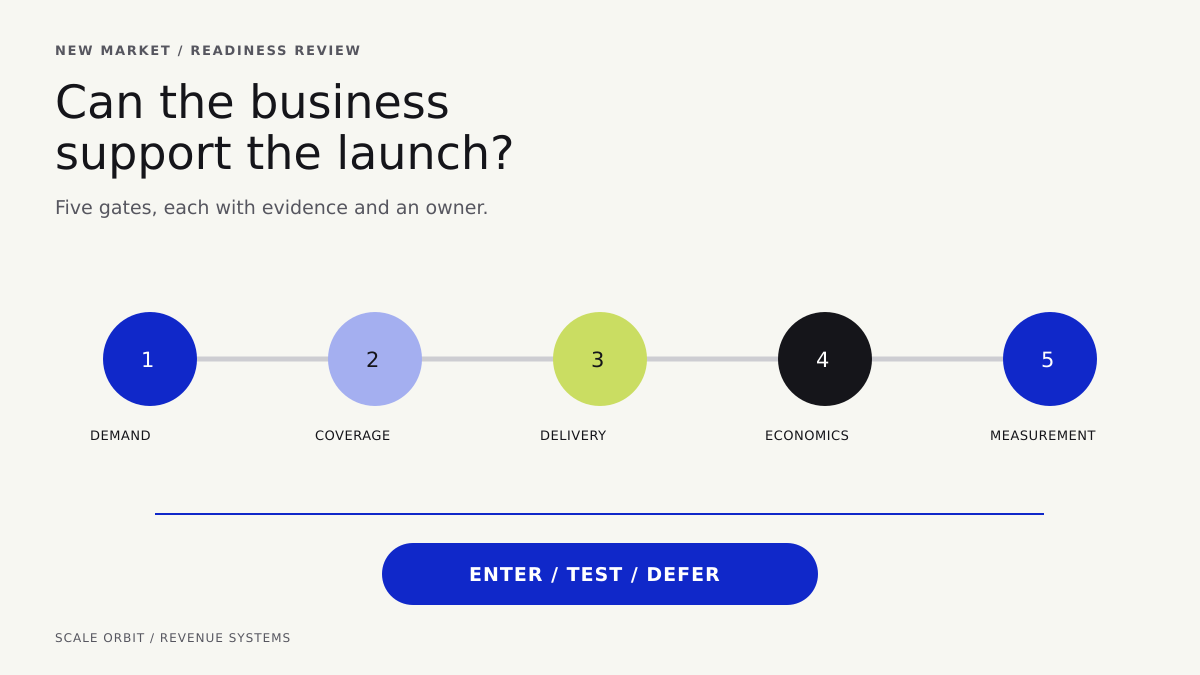
A country can look attractive in a market plan and still be a poor launch decision this quarter. Demand evidence, local selling coverage, delivery capacity, and measurement need to work together. A readiness review tests those conditions before a team commits to a permanent presence or a full acquisition budget.
Treat entry as an operating decision
Market entry is not only a question of whether buyers exist. A viable opportunity needs a path from first exposure to a qualified conversation, a credible sales owner, and a service model that can fulfill what the campaign promises. If any link is missing, a marketing launch can produce activity without a reliable way to learn or convert it.
Start with a specific target segment and buying problem. A broad country label hides differences between company types, procurement routes, language needs, and delivery constraints. State which buyers the team will pursue and what evidence would make that segment worth serving.

Review five readiness gates
| Gate | Evidence to review | Decision owner |
|---|---|---|
| Demand | Buyer conversations, active opportunities, or another direct signal | Market or sales lead |
| Coverage | Named seller, timezone overlap, language and escalation route | Sales leader |
| Delivery | Implementation, support and fulfillment path for the offered scope | Delivery owner |
| Economics | Expected contract shape, acquisition effort and cost to serve | Finance and GTM |
| Measurement | Market, source, currency and cohort definitions in reporting | RevOps or analytics |
Evidence should be specific to the segment and dated. A list of competitors or a large addressable-market estimate does not show that the team can reach buyers or deliver the offer. Separate direct observations from assumptions, and name the person who can validate each one.
Prefer evidence that reflects a buyer action: a relevant evaluation, a request tied to a real operating problem, an introduction to the person who owns the process, or an opportunity with a documented next step. General interest, an event badge scan, or a translated website visit can help form a hypothesis, but each needs additional context before it supports a market decision. Record where the evidence came from and when it was observed.
Choose enter, test, or defer
Use an enter decision when the main gates have credible owners and the team can support the expected buyer path. Choose a bounded test when demand is plausible but one or more assumptions need evidence. Defer when the offer cannot yet be served, no sales owner can handle qualified interest, or the available measurement would make the result uninterpretable.
A test should have a specific question, limited audience, responsible owner, review date, and a stop condition. Do not call an open-ended campaign a market test simply because its spend is small. The test needs to reduce a decision-relevant uncertainty.
Keep readiness gaps visible after launch
Readiness changes as people, budgets, and local operating conditions change. Review open gaps at the same cadence as the market plan. If the seller leaves, support coverage changes, or the product scope shifts, re-evaluate whether the original launch assumptions still hold.
The practical output is a decision with named evidence and owners—not a score that conceals a missing capability. A market-entry framework can set the strategic direction; this readiness review determines whether the business is prepared to act on it now.
For market sequencing, see the international B2B market-entry framework; for a related operating constraint, review capacity utilization and growth spend.
How did this article land?
Choose one reaction. You can change it anytime.