

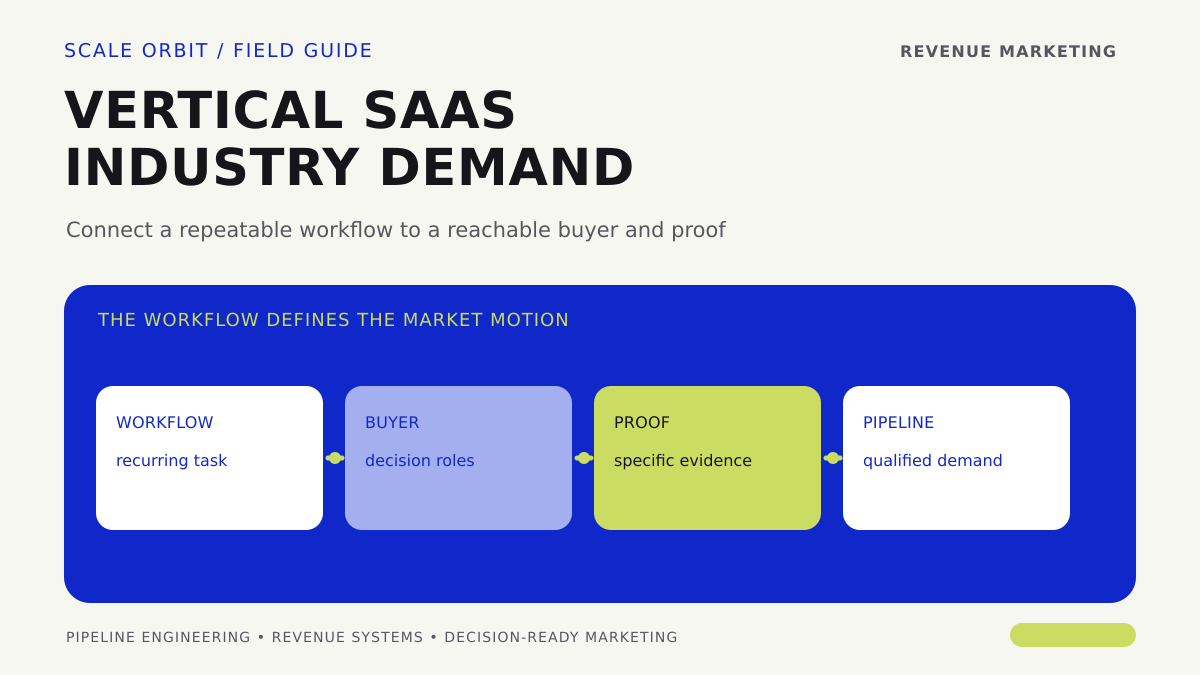
Vertical SaaS marketing works when the company makes a specific industry workflow easier to understand, evaluate, and buy. The label “vertical” is not enough. A product may serve one industry yet still speak in generic feature language; a focused marketing motion starts with a recurring buyer task and shows how the software fits that work.
This is different from choosing between vertical and horizontal product models. The practical question here is how a team that has chosen a vertical can create demand without spreading its message across unrelated subsegments.

Choose the workflow before choosing the channel
Begin with a repeatable task or decision that creates a reason to look for software. Ask which role experiences the friction, how often it occurs, what consequence follows when it remains unresolved, and who can approve a change. Industry vocabulary helps, but the commercial case comes from the work being improved.
- Frequency: Does the task happen often enough to support an ongoing product relationship?
- Ownership: Can the buyer and the person who experiences the problem be identified?
- Value: Can the organization describe a meaningful outcome without relying on an unsupported savings claim?
- Proof: Can the product demonstrate the workflow using evidence the company is allowed to share?
- Delivery: Can the team support the integrations, onboarding, and service expectations associated with this segment?
Map the buying group around the workflow
A vertical product may be evaluated by an operator, a functional leader, IT, finance, or an executive sponsor. Their questions differ. The operator wants to know how daily work changes; a technical reviewer may ask how information moves between systems; a budget owner needs a clear commercial case. Map these roles from customer conversations instead of assuming one persona represents the whole account.
Use the workflow map to shape pages, demos, and follow-up. A good page explains the task, the role it helps, the point where the product enters the process, and the next step. A good demo uses a relevant scenario. Avoid industry-specific terminology that sounds authoritative but does not help a buyer make a decision.
Build proof that is specific and defensible
Evidence can include an annotated workflow, a product demonstration, customer-approved examples, implementation prerequisites, or a clear explanation of what the product does not yet support. Do not invent efficiency metrics or present one customer’s result as typical. When no customer case is approved for publication, show the product’s capabilities honestly and describe the assumptions in any illustration.
Select channels by access and follow-up capacity
Search content may capture buyers researching a defined task. Industry associations, specialist partners, events, and customer referrals may help when trusted access matters. Paid media can extend a validated message, but it should not be treated as a substitute for a coherent segment and follow-up path. Choose a small number of routes that the team can serve and measure.
The broader B2B demand-generation framework helps connect channels to pipeline. The existing vertical versus horizontal SaaS comparison addresses product and go-to-market trade-offs; this article focuses on the marketing system after a vertical is selected.
Measure by segment, not by the broad industry label
Track qualified conversations, accepted opportunities, stage progression, sales-cycle movement, and implementation fit by subsegment or workflow when the sample supports it. A campaign that attracts a large industry audience can still miss the buyer task. Review lost and deferred opportunities for evidence that the segment, proof, or offer needs adjustment.
If the company plans to enter another country, add local buyer access, language, partner readiness, and delivery capacity to the decision. The international B2B market-entry framework provides a separate checklist for geographic expansion.
A focused vertical SaaS strategy links a particular workflow to a reachable buyer, credible proof, and a delivery path the company can support. That system is more useful than an industry label or a list of channels.
How did this article land?
Choose one reaction. You can change it anytime.