

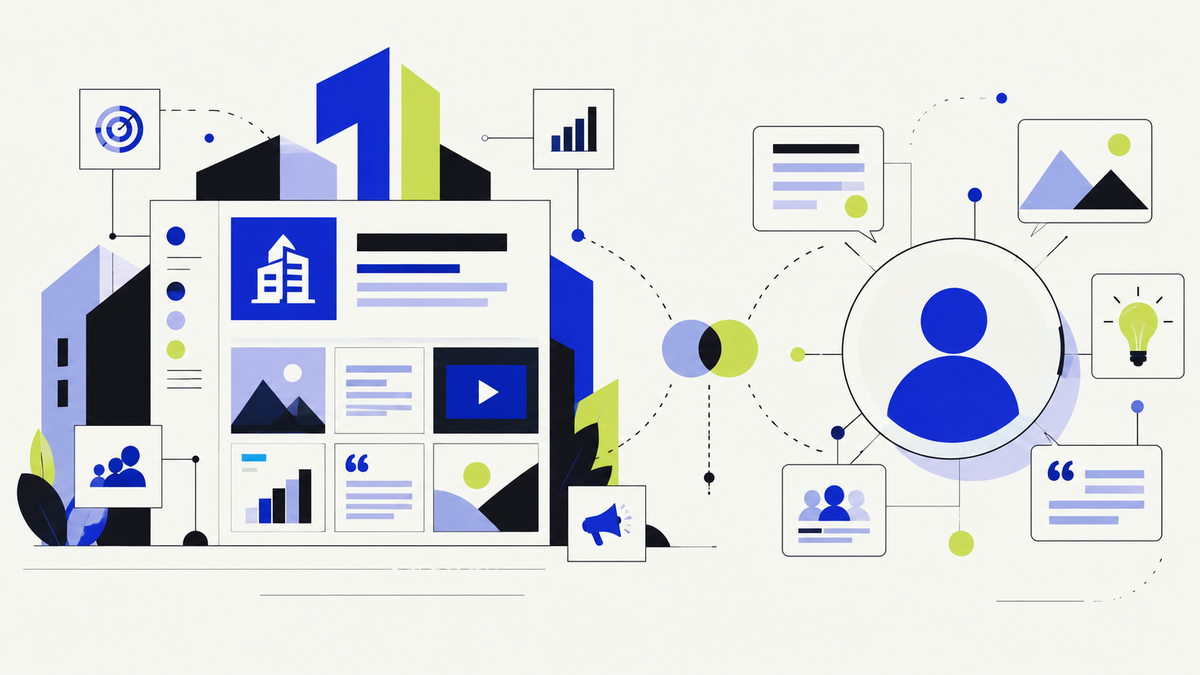
Should a B2B company publish through its LinkedIn Page or the personal profiles of founders and subject-matter experts? Use both when they perform different jobs. The Page should be a durable, accountable record of the company’s capabilities and evidence; a real person can explain the judgment and experience behind that evidence. The right mix depends on the buying group, available expertise, and who can maintain a useful conversation—not a universal ranking of LinkedIn’s algorithm.
LinkedIn explicitly distinguishes Pages as organizational identities and profiles as individual identities. A personal profile must belong to a real person; it is not an alternative corporate account. That distinction should shape publishing, access and measurement.

The short answer: assign a different job to each surface
| Decision | Company Page | Personal profile |
|---|---|---|
| Primary promise | Reliable company information, product and service updates, reusable proof | Experience, perspective, context and direct professional conversation |
| Best content | Approved research, implementation explainers, documented changes | First-hand trade-offs, informed objections, expert interpretation |
| Accountability | Page admins and company editorial owners | The individual author, with consent and professional boundaries |
| Suitable next action | Read a resource, inspect the offer or contact the right team | Discuss an issue, test a perspective or inspect a useful reference |
| Measurement | Page audience, content interaction, relevant visits and lead follow-up | Post discovery, relevant discussion and trackable referral visits |
Neither channel is automatically “awareness” or “conversion.” The same finance director may read a technical leader’s explanation, visit a company Page to check legitimacy, then ask a colleague to forward an internal brief. Those touchpoints answer different evaluation questions and cannot be converted into separate, exact revenue credits.
Let the buying group—not the content format—drive the strategy
An executive sponsor, implementation lead, budget owner and risk reviewer rarely need identical content. A specialist can explain why a particular workflow is difficult; the company can document what the system supports, how evidence is validated and who is accountable for delivery. The goal is to give each reader a useful answer before they have to make or defend a decision.
The 2025 Edelman–LinkedIn B2B Thought Leadership Impact Report, based on a study of nearly 2,000 professionals, emphasizes the role of less-visible stakeholders in buying decisions. Its findings support creating valuable expertise for the wider buying group. They do not demonstrate that a certain posting frequency, content template or profile type guarantees revenue.
Choose the publishing owner with five questions
- Does the point require first-hand judgment? A willing operator can explain a trade-off they understand. A product specification, corporate policy or service description needs an authoritative company source.
- Who can answer difficult questions? A claim about technical performance or risk needs a responsible expert. Do not publish from an executive profile if the person cannot or does not want to stand behind the discussion.
- Should the information outlive the author? Durable implementation procedures, support routes and customer-approved evidence belong in company-owned knowledge assets.
- Has the claim been approved? Personal storytelling does not override confidentiality, customer approval, contractual limitations or regulated disclosures.
- What action actually helps the reader? An early-stage reader may need a checklist or explanation, not an immediate sales meeting.
One buyer problem can produce two genuinely different posts
Consider a B2B SaaS team explaining the gap between platform-reported conversions and sales-accepted opportunities. Its company Page can publish an inspectable method: which CRM fields matter, how stages are defined, and what evidence is needed before a number reaches a revenue dashboard. A RevOps expert can publish a personal analysis of a common failure mode: why a dashboard appears to improve while sales sees no improvement, how they would investigate it, and what evidence might change their conclusion.
That is not a license to post the same paragraph twice. The Page carries a repeatable process; the individual carries a reasoned perspective. Each post must work on its own. If the scenario is a teaching example rather than a verified client case, label it accordingly. Never invent a customer name, financial result or personal experience.
Build two editorial tracks without manufacturing personalities
Begin with real buyer questions rather than a fixed quota of daily updates. For each question, record its source, the buying role, the claim the company can support, the required reviewer and the most useful next action. Then decide whether a durable company explanation or an authored perspective is more valuable—or whether both add genuinely different information.
- Company track: a research-backed explainer, approved product clarification, useful process diagram or source page that the company can maintain.
- Expert track: a first-person interpretation, limitation, counterargument or practical lesson that the author personally understands and agrees to share.
- Coordination: credit contributions, request approval, add context when resharing and avoid identical captions or artificial engagement circles.
- Feedback loop: collect recurring buyer questions and update the underlying reference when comments expose a gap or error.
LinkedIn’s own Page best-practice documentation describes Page analytics, employee spotlights, publishing formats and scheduling. These are options, not reasons to impose an arbitrary cadence. This decision framework complements Scale Orbit’s broader B2B social media strategy and the separate guide to a voluntary employee advocacy program.
Measure the two tracks without claiming invisible pipeline
Keep platform activity, observable movement to company-owned assets and downstream commercial outcomes in distinct reporting layers. A post can be useful without producing a tagged click. Conversely, a large view count can contain many people who will never buy.
| Evidence layer | Useful observations | What it cannot prove |
|---|---|---|
| Company Page | Content engagement, Page visitor and follower trends, relevant site visits | That a specific individual purchased after seeing a post |
| Expert profile | Estimated impressions, saves, relevant questions, outbound link clicks where available | That all reached users are buyers or that messages are qualified leads |
| CRM and sales | Accepted inquiries, held meetings, account context, documented opportunity outcomes | Exclusive causal attribution to an organic LinkedIn post |
LinkedIn provides Page analytics to administrators and separate post analytics for individual members. Member analytics are private to their authors, and impression counts are estimates. Agree on what individual contributors are comfortable sharing; do not request employee passwords, account access or private message contents to complete a company report.
A buyer might save a post, share it privately and return weeks later. The dark social and direct traffic discussion explains why missing referral data should not be labeled as proven LinkedIn influence. When an inquiry occurs, use a traceable source where available and a clearly marked self-reported source where appropriate.
A six-week learning cycle worth running
Choose two buyer questions such as “how to diagnose a failure” and “how to compare approaches.” Publish a company-owned method for each and, where an expert agrees, a distinct personal interpretation. Document the target roles, distribution and context. Review the quality of responses, new objections and useful follow-up, not only impressions.
Record who posted, the topic, when the content appeared, what the audience actually asked and whether a relevant next action occurred. This is an operational comparison rather than a randomized causal experiment: author networks, timing and audience composition differ. Use the evidence to improve the content system, not to declare that one posting surface definitively causes more revenue.
Frequently asked decisions
Should a small B2B team start with the founder or the Page?
Maintain an accurate company Page as the stable reference, even if a founder is the most active voice. Publish through the founder only when they have genuine expertise and time to engage; a company must never use a fake “personal” account as its brand identity.
Should the Page repost every executive post?
No. Selectively share material that helps the company’s audience, add a company-specific interpretation and preserve the original author’s credit. An automatic identical repost makes the two surfaces redundant.
When is paid amplification appropriate?
Only when the content, permissions, audience and measurement are ready. Organic expert publishing and paid Thought Leader Ads are separate workflows. Spending on distribution does not turn engagement into a verified sales opportunity.
Bottom line: use the company Page for durable proof and the real person’s profile for accountable judgment. Organize both around the buying question, protect authenticity and measure what the evidence can actually support.
Sources checked November 1, 2026: LinkedIn Page versus profile; LinkedIn Pages best practices; LinkedIn post analytics; 2025 Edelman–LinkedIn research.
How did this article land?
Choose one reaction. You can change it anytime.