

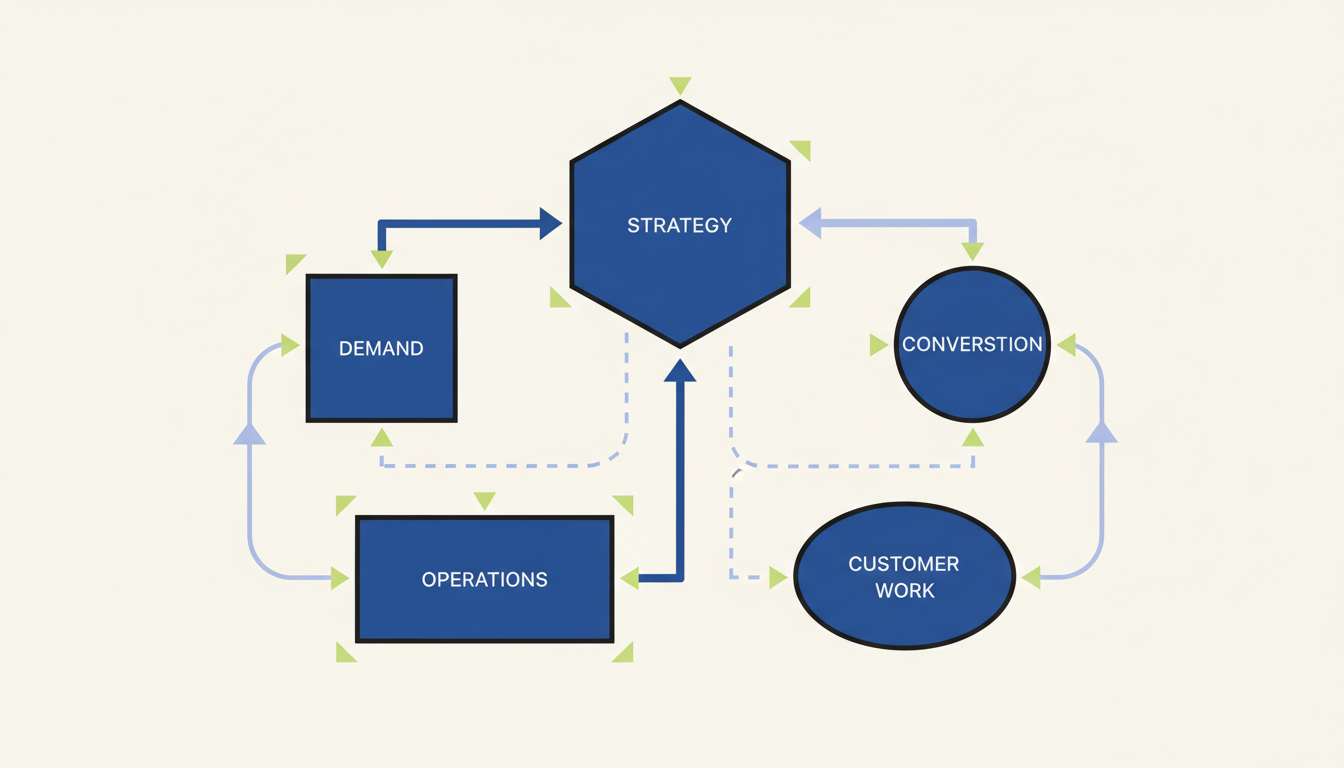
A B2B marketing team can look busy and still leave critical work without an owner. Campaigns may launch while CRM data quality, landing-page conversion, sales feedback, or measurement remains nobody’s clear responsibility. The fix is not always another hire. First define the outcomes the team owns, the capabilities required to produce them, and the capacity available to do the work well.
This framework helps a marketing leader design role coverage for a B2B or SaaS company without copying a headcount chart from a different business. It distinguishes accountability from job title and shows when to build internally, use a specialist, or work with an agency.
Organize around outcomes and capabilities
Start with the decisions marketing must support: which customers to pursue, how to create and capture demand, how to convert interest into qualified conversations, and how to show what happens after a lead enters the revenue system. Map each outcome to the capability and accountable owner it requires.
| Capability | Accountable outcome | Typical work | Key working relationship |
|---|---|---|---|
| Strategy and customer insight | Clear target segments, problems, and market choices | Research synthesis, positioning, planning, prioritization | CEO, product, sales leadership |
| Demand creation and capture | Relevant buyers can discover and evaluate the offer | Campaigns, channels, content, paid media, partner activity | Sales, product marketing, external channel specialists |
| Conversion and experience | Interested visitors and accounts can take a useful next step | Landing pages, forms, experiments, message continuity | Design, product, sales development |
| Marketing operations and data | Records, workflows, and reports support consistent decisions | CRM governance, tracking, automation, quality checks | RevOps, analytics, IT, privacy specialists |
| Customer lifecycle | Customers receive relevant education and expansion support | Onboarding communication, adoption programs, advocacy | Customer success, support, product |
These capabilities do not require five separate full-time roles. One person may cover several areas in an early team; an external specialist may fill a narrow technical gap; a mature organization may assign a dedicated owner. The important condition is that every recurring decision has a named accountable person and a realistic amount of time.
Find the real capacity constraint
Inventory the work the team has committed to, then separate it into recurring operations, planned programs, urgent requests, and improvement work. Estimate effort from the team’s own recent cycles instead of using generic market benchmarks. Note specialist dependencies, approval delays, and the tasks that repeatedly wait for sales, product, finance, or legal input.
- Backlog: What work is repeatedly requested but never completed?
- Throughput: Which deliverables are consistently finished, and which slip when priorities change?
- Quality: Where do corrections, rework, broken tracking, or unclear claims consume capacity?
- Dependencies: Which tasks cannot move without a decision or asset from another team?
- Risk: What knowledge, access, or process exists with only one person?
The constraint may be focus rather than headcount. If a team has more active priorities than it can finish, adding a role can increase coordination without increasing completed work. If work stalls because specialist judgment or system access is missing, a targeted hire or external engagement may be more useful than another generalist.
Decide what belongs inside and what can be bought
Keep strategic ownership, customer context, and high-frequency decisions close to the business. Consider outside support for specialized work that is intermittent, technically demanding, or faster to obtain than to build. A practical decision should account for control, continuity, cost of coordination, access to expertise, and the consequences of a handoff.
An external partner should have a defined scope, an internal owner, access to the right evidence, and a handover standard. Internal work also needs a clear brief and review path. A comparison of agency, specialist, and in-house options can help with individual workstreams; for marketing operations specifically, see outsourcing versus an in-house hire.
Make interfaces explicit
Many team problems are handoff problems. Define when marketing accepts a request, what information a campaign must contain before launch, who can approve a claim, which team owns lead response, and how sales feedback returns to the next planning cycle. Put these agreements where the teams work rather than relying on memory.
For each recurring workflow, write a short operating note with its trigger, owner, inputs, expected output, exception path, and review date. Avoid process documentation that nobody uses. The test is whether a new team member can identify the next action and owner without asking three people.
Review the structure through work, not titles
Review role coverage when the customer segment, sales motion, product complexity, or workload changes. Look for work that has no owner, duplicate approvals, overloaded specialists, or a growing queue of recurring repairs. Tie the review to outcomes such as qualified pipeline, conversion quality, data reliability, and customer progress, while keeping leading operational indicators visible.
A useful team design makes ownership clear and capacity honest. It can change as the company grows without changing its purpose: connect customer insight to demand, demand to a reliable sales process, and marketing activity to commercial evidence.
How did this article land?
Choose one reaction. You can change it anytime.