

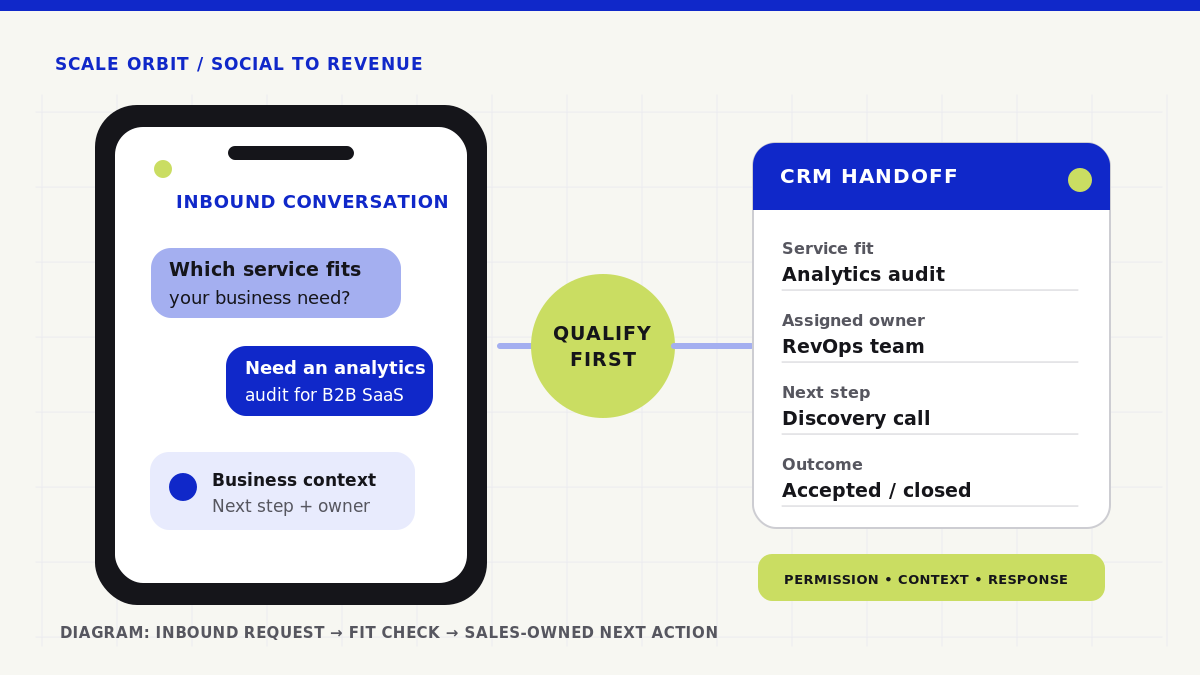
An Instagram DM becomes a B2B lead only when the conversation reveals a business need the company can serve and there is a legitimate next step. A price question, customer-support issue, Story reaction and serious request for a proposal should not all produce the same CRM opportunity. The job of an Instagram DM workflow is to respond usefully, qualify proportionately and preserve the right context when a named owner takes over.
This framework is for B2B service firms and sales-assisted teams receiving inbound Instagram conversations. It is not a method for scraping contacts or sending unsolicited automated outreach. A native Meta Instant Form is a different input with its own data contract; Scale Orbit separately explains how to route Meta form submissions into a CRM.

First classify the message, then choose its next action
Create a short triage vocabulary to help the response team act consistently. It should not force every message into a sales funnel. Four initial states are often enough: information request, potential new-business project, existing-customer support and irrelevant or unavailable request. Keep a clear reason whenever a request is outside the company’s service boundaries.
| Conversation state | Next useful action | Open a sales opportunity? |
|---|---|---|
| General question | Answer or refer to accurate information; note recurring questions in aggregate | No, unless a genuine business need emerges |
| Potential B2B project | Clarify service need, business context, timing and next owner | Only after a qualified handoff is accepted |
| Existing customer request | Route to the authorized support team without losing context | No separate new-business opportunity by default |
| Out-of-scope request | Respond respectfully; close or refer if appropriate | No; record the reason |
Capture the entry point without inventing source precision
A person may start a conversation after visiting a profile, replying to a Story, seeing a post, receiving a referral, or clicking an ad. Not every message comes with a reliable source identifier. Store the campaign, asset or post when the platform or approved integration makes that information available. Otherwise use an explicit “unknown” or “user-reported” origin rather than guessing which post caused the inquiry.
Meta’s Business Suite Inbox instructions explain how authorized users can read and reply to Instagram messages alongside other business channels. For connected third-party messaging providers, Meta documents conversation routing, including which integrated app receives and handles replies. Account access and permissions must be checked before automating anything; these capabilities do not mean every account has identical features or complete attribution.
A two-question discovery sequence beats a long chatbot form
Acknowledge the person’s request first. The next question should establish what they actually want, such as whether the business needs a new website, conversion work on an existing site, or help with analytics. A second question might clarify service geography, company context or decision timing. Do not demand five personal fields before answering a simple factual question.
Illustrative response for a B2B web studio: “We can help assess that. Is your priority a new site, improving conversion on an existing site, or fixing tracking? I can direct the request to the right person once I understand the project.”
This is a teaching example, not a documented conversion result. A clinic, software firm and contractor require different questions and safeguards. A regulated service may need professional review and tighter limits on collecting sensitive information. Never ask people to send confidential files through a casual DM just to qualify a sales conversation.
Design the actual handoff: from social inbox to responsible CRM owner
Transfer a conversation when it contains enough context for a named owner to take a useful next action. Do not automatically create a lead record for every Instagram handle. A sales-accepted handoff means the receiver has the request, understands the next step and has an authorized way to respond. If the ownership request is declined or misrouted, the original responder must know what happens next.
- Identity and consent: record contact details only when voluntarily provided for a stated purpose; check the appropriate permission before changing channels.
- Business need: store the service requested, relevant business context, fit status and next unresolved question—not a speculative deal value.
- Source integrity: mark the origin as an Instagram inbound message and preserve a post or campaign identifier only when genuinely available.
- Operational ownership: assign a teammate, an acceptance state, next action and a reasonable response expectation tied to real operating hours.
- Deduplication: compare approved matching fields against existing CRM records before opening another lead or opportunity; send uncertain matches for manual review.
- Privacy boundary: keep a concise business summary by default rather than copying the entire private thread and unnecessary personal data.
Map the exceptions before expanding automation
The happy path is simple; errors are expensive. A team needs to know what happens when a response fails, an inbox is unattended outside working hours, a customer-support request reaches sales, an inquiry is outside coverage or a CRM match cannot be resolved. Write down the fallback owner and next step for those cases. A good process does not need to promise 24/7 service when the organization cannot deliver it.
Start with the native inbox or an authorized integration. If automation is introduced, check the current Meta messaging permissions, conversation-window rules, disclosure expectations and human escalation capability. Meta announced expansion of its Business Agent to Instagram in 2026, including features for answering questions and qualifying inbound leads. Availability and exact scope depend on the product and account; do not advertise a universal capability or replace a responsible human owner.
What to measure: five stages, not one inflated lead count
| Stage | Working definition | Decision supported |
|---|---|---|
| Inbound conversations | New inbound threads during the reporting period | Staffing and response coverage |
| Serviceable inquiries | The request falls inside an actual service or geography | Audience and offer quality |
| Qualified conversations | Need, buyer context and next step are sufficiently clear | Whether to involve sales |
| Accepted handoffs | Named CRM owner confirms responsibility and the next action | Handoff reliability |
| Held meetings / opportunities | Verified follow-up and CRM milestones, not calendar invitations alone | Commercial progression |
A hypothetical calculation shows why the definitions matter. Suppose 80 new inbound conversations contain 25 serviceable business inquiries; 12 become sufficiently clear for handoff and nine are accepted by sales. The serviceable share is 25 ÷ 80 = 31.25%. Handoff acceptance is nine ÷ 12 = 75%. These are invented instructional numbers, not Scale Orbit client results or industry benchmarks. One ratio diagnoses demand fit, the other operational ownership.
Also review unanswered requests, delayed responses during staffed hours, duplicate CRM records, misrouted support and handoffs with no action. All can signal damage to the buyer experience even as total DM volume rises. Treat a message sent, a reply received, a held meeting and verified revenue as different events.
Run a bounded four-week operating improvement
- Week 1 — baseline: sample authorized inbound conversations, classify real request types and identify repeated unresolved questions. Protect private details in the analysis.
- Week 2 — response design: create two service-fit questions, define owners, business-hour expectations and clear routes for support and unavailable requests.
- Week 3 — handoff quality assurance: use controlled test conversations with proper permission to verify context retention, CRM matching, ownership notification and exception handling.
- Week 4 — outcome review: compare serviceable requests, accepted handoffs, response quality and lost-context examples. Improve one bottleneck at a time.
This process review cannot by itself establish that a specific post produced a sale. Seasonal demand, account activity, staffing and campaign mix may change. If marketing wants credible revenue measurement, retain traceable identifiers only where lawful and available, keep self-reported discovery separate and resist reverse-engineering causality from follower or message counts. See Scale Orbit’s social media metrics guide for the broader reporting boundary.
Common Instagram DM decisions
Should every inbound DM receive an automated answer?
No. Low-volume, high-context inquiries may be better served by humans. An approved acknowledgement can establish expectations, but automation must have an owner, honest disclosure, fallback and compliant sending conditions. Do not pretend a bot is an account manager.
Should the conversation immediately move to email or a calendar?
Only when that channel is needed for the person’s task and the person agrees to provide details for that purpose. An Instagram message is not blanket permission to add someone to unrelated email sequences. A calendar booking is not evidence that a qualified meeting happened.
Is an Instagram contact automatically an SQL?
No. A handle, email address or incoming question is not sales qualification. Define evidence and require sales acceptance if SQL is a CRM stage. Apply comparable criteria regardless of whether a request starts in Instagram, on a website or through a referral.
Bottom line: inbound Instagram DMs become a useful B2B demand source when questions receive appropriate responses, genuine project fit is checked, ownership is accepted, and the outcome is verified. Improve that path before scaling conversation volume or adding automation.
Sources checked November 1, 2026: Meta Business Suite Inbox; Meta conversation routing; Meta Business Agent announcement.
How did this article land?
Choose one reaction. You can change it anytime.