

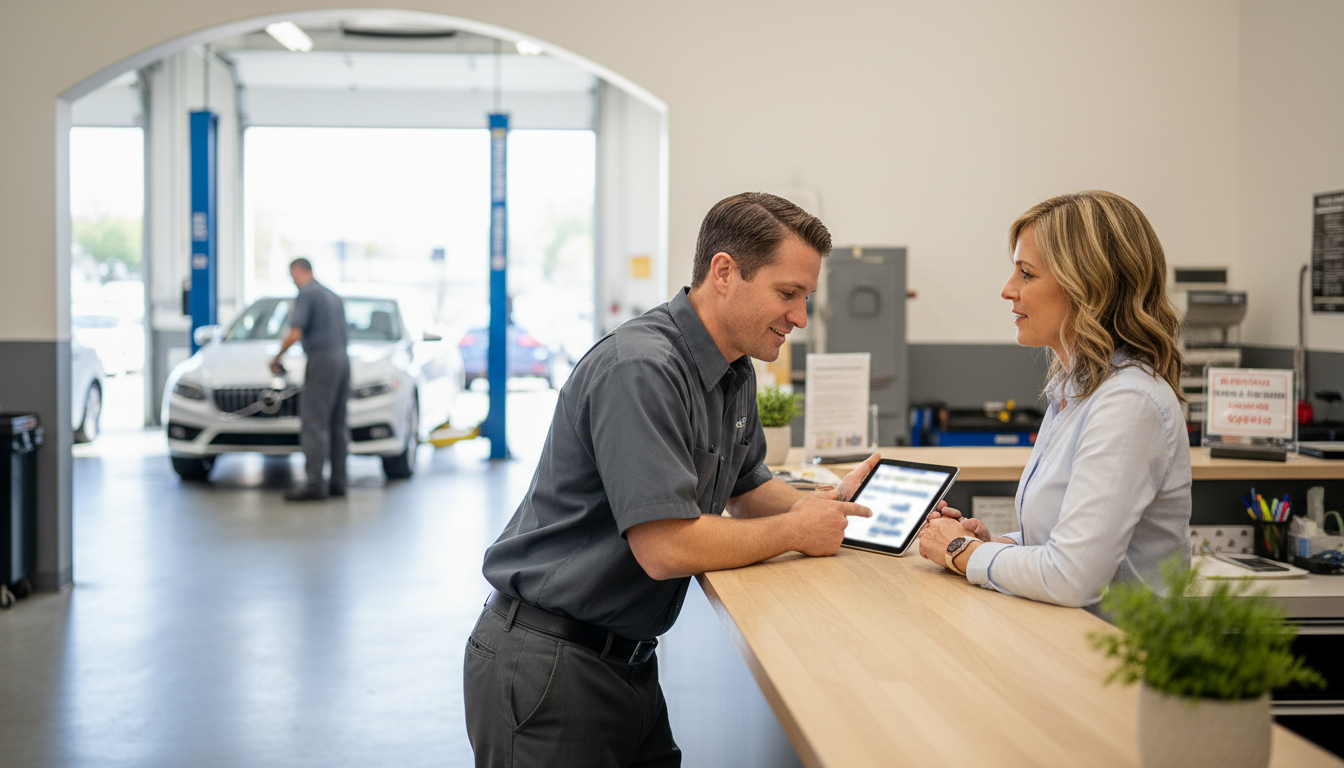
Most auto repair shop marketing advice starts with “get more calls.” But a call may come from outside your service area, ask for work your shop does not perform, or expect a fixed price before anyone has inspected the vehicle. A reliable marketing system connects local discovery to verified repair capabilities, clear estimate expectations, and the bays and technicians actually available. The useful outcome is a suitable vehicle arriving with the owner prepared for the next step.
The Federal Trade Commission’s Auto Repair Basics advises consumers to ask how a shop prices work, whether diagnostic charges apply, and for a written estimate. The National Institute for Automotive Service Excellence explains how its credentials help customers gauge a technician’s knowledge; a credential is evidence to describe accurately, not a promise that every repair will be perfect.

Define what the shop can confidently book
Start with the work your team is equipped and staffed to perform. List accepted vehicle types and service categories, the geographic area you can realistically serve, and the diagnostic or estimate process for work that cannot be priced from a short description. Confirm this information with the service manager before it appears in ads or on the website.
| Search or request | Page should explain | Shop should verify |
|---|---|---|
| A specific service | Which vehicle types and service scope the shop accepts. | Technician skill, tools, bay time, and parts availability. |
| A diagnostic request | How inspection, diagnostic charges, and estimate approval work. | Who reviews the vehicle and how the customer is updated. |
| A nearby appointment | Exact location, hours, contact path, and available booking route. | That the schedule can honor the time shown online. |
Build focused pages around services the shop genuinely offers instead of creating near-duplicate pages for every nearby town. Each page should answer a real decision: whether the shop handles the vehicle and work, what information helps route the request, and what happens before a repair is approved. Do not promise a diagnosis or firm repair price from a symptom description alone.
Make local discovery prove the shop is a fit
Complete the Google Business Profile with the correct business name, address or service area, hours, phone, categories, and current photos. Google says local results are mainly based on relevance, distance, and prominence, and there is no way to request or pay for a higher local ranking. Keep service descriptions accurate so the profile attracts the right local request rather than every possible car owner.
If an appointment or service link is available for the shop’s profile, send it to a dedicated page for that location and let the customer complete the intended action there. Google’s business-link policies say links should lead to a dedicated landing page and enable the stated action. If the schedule is managed by phone, make the call route easy to use on mobile and tell visitors what details will help the advisor respond.
Local-search guidance for auto shops often emphasizes accurate profiles, reviews, service pages, and real shop photos. A useful further step is to connect those discovery signals to the actual service desk: a profile can generate interest, but the booking path must explain the diagnostic and estimate process that follows.
Turn the first inquiry into a suitable appointment
Make it easy for an advisor to route a request without asking a driver to diagnose a vehicle online. A short booking form or call script can capture the customer’s location, vehicle year/make/model, the service they are seeking or concern they want assessed, preferred contact method, and a workable time window. Ask only for information that helps the team decide fit and schedule.
- State what happens after a request: who replies, through which channel, and what the next confirmation means.
- Explain diagnostic fees and estimate approvals using the shop’s actual policy; do not hide a charge behind a misleading “free inspection” offer.
- Confirm the appointment with the correct location, arrival time, and any administrative details the service team wants customers to know.
The FTC guide notes that customers may ask for a written estimate and that the estimate should identify the condition, parts, and anticipated labor charge. Use that consumer expectation to improve marketing clarity: describe how the shop communicates findings and seeks approval before additional work, while checking applicable state and local rules with qualified counsel.
Match promotion to technician and bay capacity
A shop’s real inventory is not unlimited demand; it is the combination of available bays, technician skills, diagnostic tools, parts, and service-advisor coverage. Before promoting a service, identify the days and appointment windows the team can support. If a specialized technician is booked, route the campaign to a later date or a different service the shop can actually deliver.
This capacity-first approach also appears in our HVAC marketing strategy guide: the campaign should reflect the service team’s real ability to respond. For an auto shop, that means adjusting by work type and vehicle fit, not just filling every open bay with any request.
Use offers carefully. A clearly scoped maintenance package or seasonal check can make a decision easier when it reflects a real service the shop is prepared to perform. Put the included work, exclusions, dates, and any diagnostic charge in plain language. Avoid urgency claims or low headline prices that depend on customers accepting unrelated repairs.
Measure the path to completed work
Track requests through a small, consistent funnel: inquiry received, qualified for the shop, appointment scheduled, vehicle arrived, estimate discussed, work approved, and repair completed. A form submission or answered call is not the same as a repair order. Use call-source tags, booking questions, or campaign codes to connect marketing with service records, then acknowledge that some customers will use more than one discovery channel.
| Metric | What it helps diagnose |
|---|---|
| Cost per qualified request and per arrived vehicle | Whether media reaches drivers the shop can actually serve. |
| Response time and appointment show rate | Whether the service desk and schedule are converting demand. |
| Estimate approval and completion by service type | Whether expectations, scope, capacity, or pricing communication need review. |
| Repeat visits and customer feedback | Whether the experience after the ad supports trust and return service. |
Do not optimize only for estimate approval or average invoice. A sharp change can indicate a mismatch between advertising, inspection findings, and customer expectations. Review the story behind the metric with service advisors and technicians; the aim is a clear decision process and work the shop can complete well.
Use a service-line launch brief before spending
Give the service manager and marketer one shared launch card for the repair category. It turns an ad idea into an operational promise the shop can verify before a call comes in.
| Launch-card field | What to write down | Who confirms it |
|---|---|---|
| Vehicle and service fit | Accepted vehicle types, service scope, and location. | Service manager or lead technician. |
| Estimate expectations | Diagnostic policy, what an estimate includes, and how approvals are handled. | Service advisor and owner. |
| Available capacity | Appointment windows, technician coverage, and parts constraints. | Shop scheduler. |
| Booking path | The exact page, call route, or scheduler that completes the next action. | Marketing and front desk. |
| Success evidence | Qualified requests, arrived vehicles, completed work, and a source label. | Marketing and service desk. |
If the shop cannot confirm one of these fields, fix the information or schedule before advertising the service. This simple handoff protects trust: the marketing promise and the service desk are describing the same job.
Frequently asked questions
What is the most important part of auto repair shop marketing?
Make the shop’s service fit, location, credentials, estimate process, and booking route clear. Then measure whether suitable vehicles arrive and complete work, not simply whether a page receives calls.
Should an auto repair shop advertise a low-cost diagnostic?
Only if the price, scope, eligibility, and next step are clear and accurate. Diagnostic work may have a separate fee or depend on the vehicle, so explain the shop’s policy before the customer books.
How can a repair shop build trust online?
Use current team and facility photos, accurately described credentials and services, transparent information about estimates and diagnostic charges, and respectful review responses that do not disclose customer or vehicle details.
Sources and platform references
- Federal Trade Commission — Auto Repair Basics
- Automotive Service Excellence — About ASE certification
- Google Business Profile — Tips to improve local ranking
- Google Business Profile — Business links policies and guidelines
- Shopmonkey — Local search for auto shops
How did this article land?
Choose one reaction. You can change it anytime.