

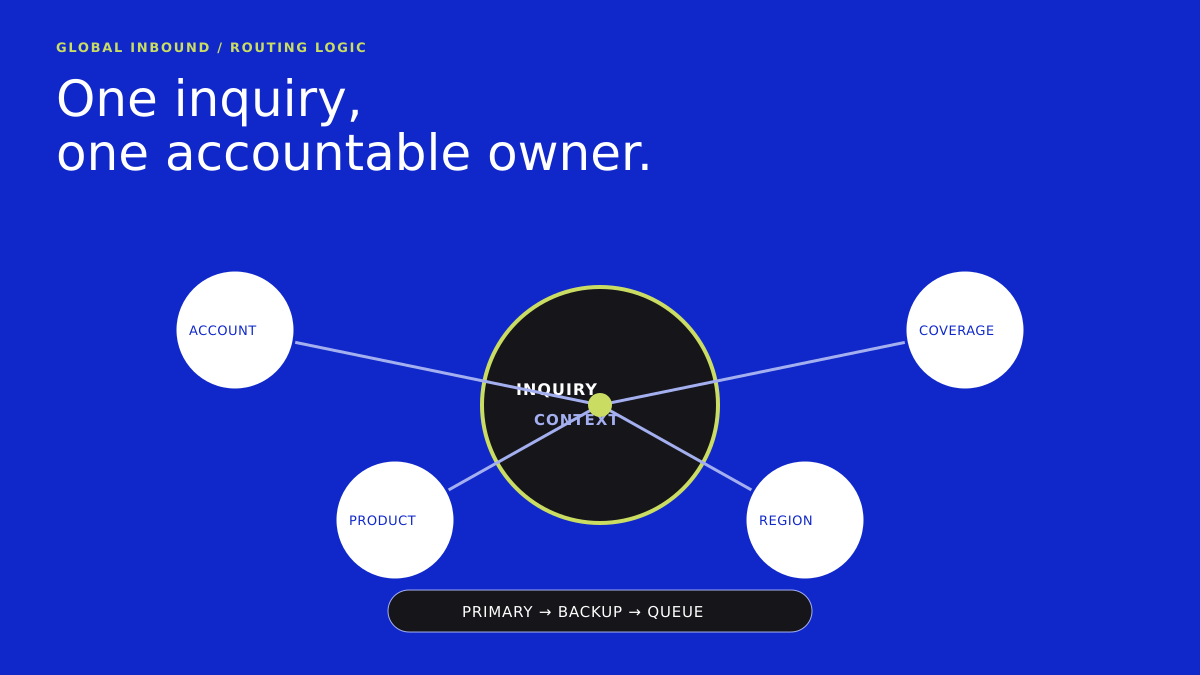
An international form submission can arrive from a subsidiary, a head office, or a buyer who is researching for a team in another country. Routing by IP country alone can send the inquiry to a seller who cannot serve the account, product, or time zone. A global rule needs an ordered decision path and a safe fallback.
Define the routing unit
Decide whether ownership follows the account, the buying location, the product, or a named territory. For an existing customer or active opportunity, the account owner may need to remain the primary contact even when a new region is involved. For a net-new account, the local buying location and product fit may determine coverage. Write this precedence explicitly so two rules do not compete.

Use an ordered decision path
- Check for an existing account, owner, or open opportunity before creating a new assignment.
- Match the inquiry to the product or service line the buyer selected.
- Resolve the buyer’s operating location using declared information and account context; treat inferred location as a clue, not proof.
- Assign only to a team that can support the region, language, and expected buying process.
- If no eligible owner exists, send the record to a monitored regional queue with an explicit backup owner.
A country field is not a complete territory model. A global company may buy centrally while local teams evaluate the product; a regional business may use a billing address that differs from the deployment location. Capture the information needed for assignment without asking for details that the team will not use.
Plan around working hours, not assumed availability
Store each team’s coverage hours and holiday calendar in the routing design. If an inquiry arrives outside the primary team’s hours, the rule should state whether it waits for the next business window, goes to a staffed regional team, or enters a shared queue. Avoid promising continuous response when the organization has not staffed it.
Define a response target using the business calendar and measure the first human response separately from automation. A notification or email acknowledgment is not the same as a salesperson contacting the buyer. Exceptions should be visible so leaders can distinguish a coverage gap from an individual follow-up problem.
Test the route against real account patterns
Before release, run test records for a new company, an existing global account, a subsidiary with a regional owner, a product the local team does not sell, and a submission received outside working hours. For each case, write the expected owner and fallback before testing. Confirm that the CRM preserves the original region and the reason for the final assignment. Include a manual reassignment test so an operator can correct a bad route without losing the record’s history.
Make exceptions auditable
Log the original route, final owner, reason for reassignment, time received, time accepted, and any manual override. Review unmatched territories, duplicate accounts, and queue aging as operational defects. If the same exception appears repeatedly, repair the assignment model rather than adding another one-off rule.
A useful global routing system does not promise that every inquiry has a local representative. It makes the coverage boundary clear, assigns a responsible next owner, and gives the business a measurable way to identify where its market presence is incomplete.
For the underlying ownership logic, see B2B lead-routing rules and exceptions. For response coverage after the local workday, review after-hours lead coverage.
How did this article land?
Choose one reaction. You can change it anytime.