

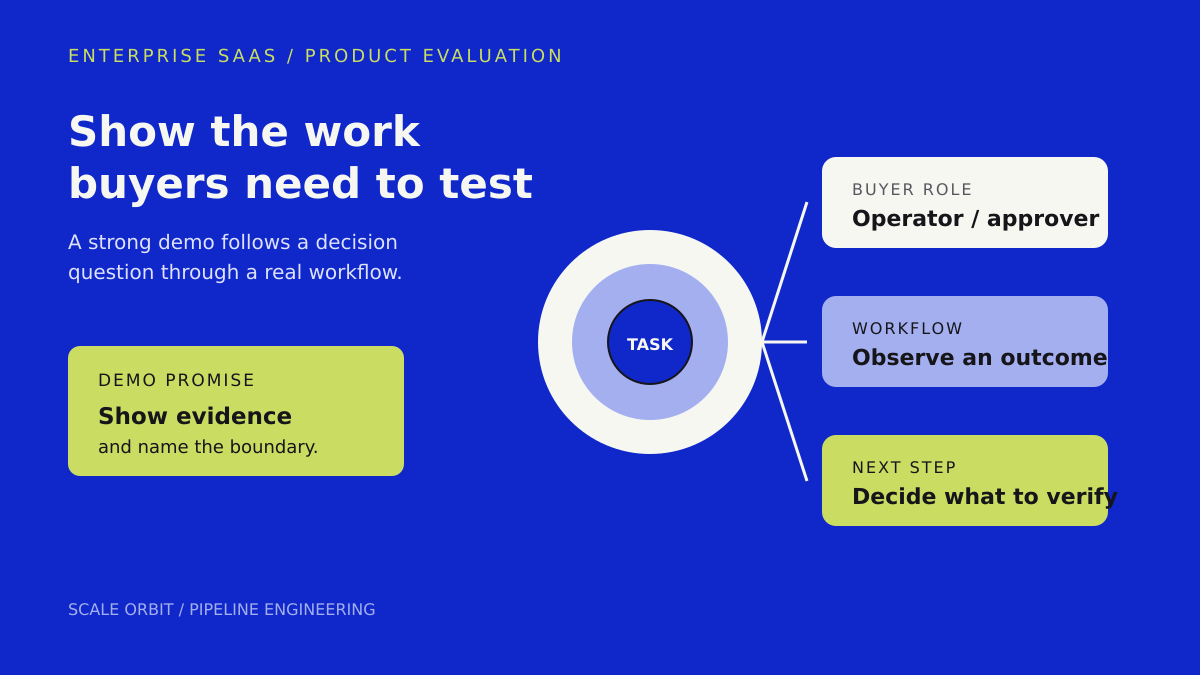
An enterprise software demo is a live evaluation, not a tour of every feature the presenter can reach. The buyer is trying to understand whether a defined workflow fits the organization, what changes for users, and which important questions still need proof. A focused demonstration gives the buying group a better basis for that judgment.
The demo should follow discovery, but it has a separate job. Discovery clarifies the problem and decision; the demonstration lets the buyer inspect a relevant product path. A calendar invite titled “platform overview” does not supply either of those things by itself.

Write the demonstration question before the agenda
State the evaluation question in one sentence: can the operations team complete a defined handoff, can a manager see the exception that requires action, or can the product support a specific workflow without the workaround the buyer wants to remove? The question keeps the presenter from substituting feature coverage for evidence.
Use discovery notes to confirm the roles in the room, the current process, the desired outcome, and any constraints the product must respect. The discovery meeting guide can help define the next buyer decision; do not repeat the entire discovery conversation in the demo.
Build a short sequence around the work
- Frame the use case and confirm that it still matters to the attendees.
- Show the starting condition the buyer recognizes, including the relevant data or role.
- Walk through the action and the system response that should change the work.
- Pause where the buyer needs to inspect an outcome, exception, or control.
- Summarize what the demo established and agree how to verify anything it did not.
A sequence should be short enough to leave room for questions. When executives, operators, and technical reviewers attend together, show a shared workflow first, then branch into a role-specific detail only when it answers a live decision question. A long feature catalogue makes it harder to distinguish proof from presentation.
Prepare the environment so the evidence is trustworthy
Use a controlled demonstration account, representative but non-sensitive sample data, and the correct permissions for the workflow. Verify integrations, loading states, and any configuration that will be visible. If a step requires manual preparation, say so; do not present a scripted workaround as an automated product capability.
Define the product boundary before the session. Identify what is available today, what requires configuration, what depends on an integration, and what remains under development. If a capability is uncertain, mark it as a follow-up item instead of improvising an answer.
Separate a demonstration from a proof of concept
A demo can show that a workflow appears plausible. It usually cannot prove performance in the buyer’s environment, validate production data, or settle every security and implementation question. When the purchase depends on those questions, define a bounded validation with a success test and named owners. The proof-of-concept guide describes how to scope that next step.
Record progress in buyer language
After the session, note which question was answered, what evidence the buyer accepted, what remained unresolved, and who will take the next action. Avoid counting attendance or time watched as evidence of purchase readiness. A demo is commercially useful when it changes the buyer’s understanding or clarifies the remaining work.
The best demonstration is selective. It helps a buyer test a real workflow, gives the team an honest record of product boundaries, and leaves a clear reason for the next evaluation step.
How did this article land?
Choose one reaction. You can change it anytime.