

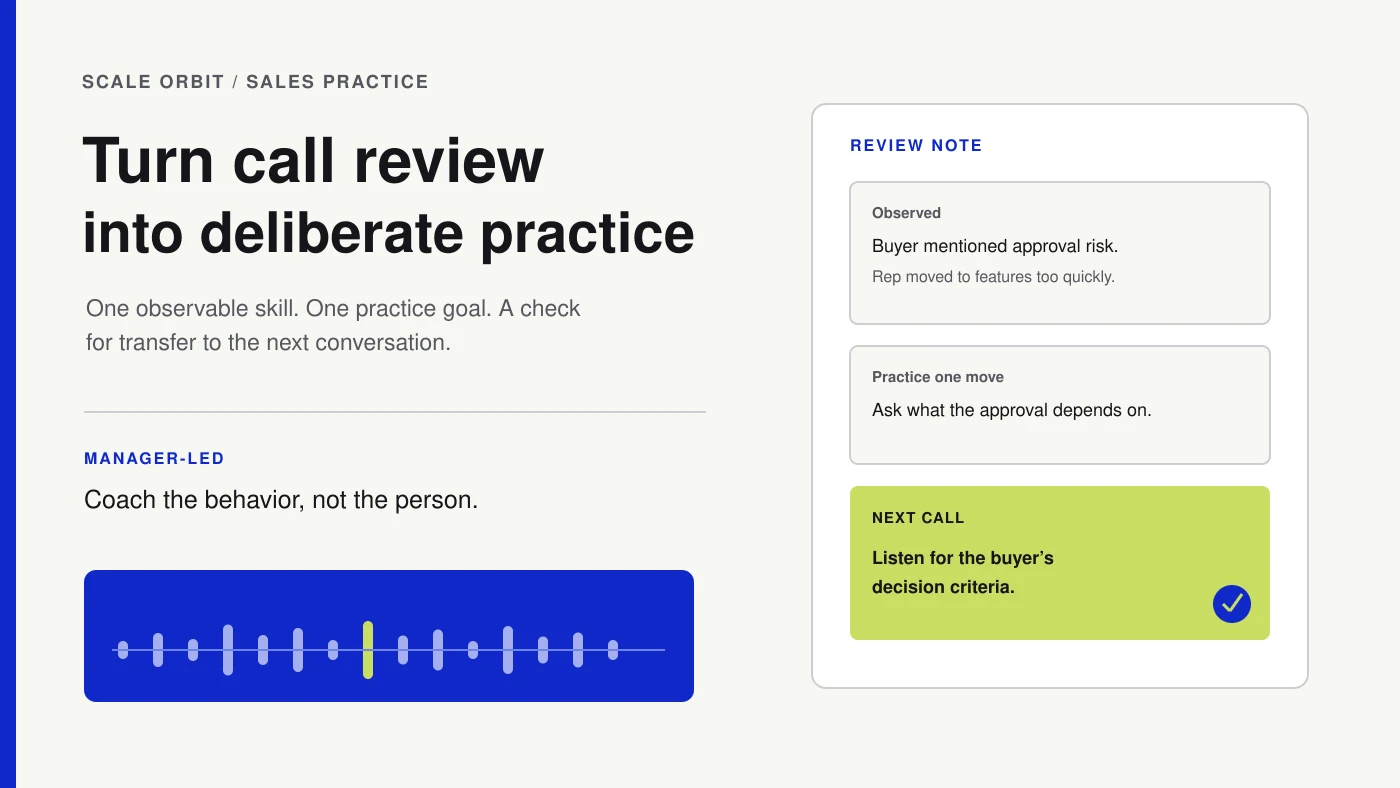
B2B sales coaching is a repeatable way for a manager to help a seller improve one observable behavior in buyer conversations. It works best when a real call provides evidence, the seller helps interpret the moment, and practice is checked in a later conversation. A scorecard can organize observations, but a number alone does not teach a skill.
This process is designed for sales managers and team leads who want call reviews to produce specific practice instead of vague feedback such as “be more consultative.” It focuses on coaching conversations, not new-hire ramp measurement or a library of sales content.
Build a simple review loop
Use the same short sequence each time: choose a relevant call moment, describe what happened, select one skill, practice an alternative, and review whether the behavior transfers to a later call.

1. Choose a call moment tied to a real skill
Start with a behavior that matters to your sales motion: clarifying a buying constraint, testing an assumption, involving another stakeholder, or agreeing on a next step. Select a short excerpt where the behavior can be observed. Explain why that moment is worth reviewing and keep the conversation within company policy for recording, access, and retention.
Use evidence from calls that reflect the rep’s actual responsibilities. A pricing conversation, first discovery, technical review, and renewal discussion require different skills. Compare similar situations when possible, and avoid using one unusual call to make a broad judgment about capability.
2. Let the seller assess the moment first
Ask the seller what they intended to learn or accomplish, what they noticed in the buyer’s response, and what they might do differently. Self-assessment helps surface context the manager may not have heard. It also makes the review a working conversation instead of a verdict.
3. Describe evidence, not personality
Point to words or actions that can be heard in the call: “The buyer said procurement would review the terms. You replied that the standard terms should be fine, then moved to the next slide.” Avoid labels such as “careless,” “weak,” or “not strategic.” Those labels are hard to act on and can obscure situational factors.
4. Agree on one observable practice goal
Choose one behavior that could change the conversation. In the example above, the rep might practice asking what procurement will evaluate, whether there is a review sequence, and what material the buyer needs. Keep the goal small enough to rehearse in the session and specific enough to notice later. Avoid assigning a long list of corrections from a single call.
5. Practice with a realistic variation
Ask the rep to try a response, play the buyer, and then switch roles. Change one detail in the scenario so the seller practices judgment rather than memorizing a line. Pause when the rep reaches for an answer before understanding the buyer’s concern, then try again. Feedback should explain what the new question or summary helps the buyer decide.
6. Review transfer on a later call
Agree on what evidence would show the behavior in a future conversation. Return to a relevant call after the seller has had a chance to practice. Notice whether the behavior appeared, how the buyer responded, and what the rep learned. If the behavior did not transfer, ask whether the goal, opportunity, confidence, or support needs adjustment before repeating the same instruction.
A coaching note the manager can reuse
| Prompt | What to record |
|---|---|
| Call moment | Stage, conversation type, and relevant excerpt |
| Seller’s goal | What the rep was trying to learn or advance |
| Observable evidence | Specific words, questions, or actions from the call |
| Practice goal | One behavior to try in a similar situation |
| Practice result | What changed during the rehearsal and what remains difficult |
| Transfer check | What to listen for in a later call and when to revisit |
Keep coaching separate from call surveillance
Call analysis can support learning, but collection volume and automated sentiment scores are not substitutes for a fair review. Explain how recordings or notes are used, follow the organization’s access and retention rules, and apply the same expectations to comparable roles and situations. If a metric is used, pair it with the call context and a way for the seller to respond or correct the record.
Keep a developmental coaching session distinct from a formal performance decision. A manager may need to address both, but combining them without explanation can make practice feel unsafe and reduce the quality of discussion. When broader patterns appear, review them with context such as territory, buyer type, deal stage, and available support.
Connect coaching to the operating system
Repeated call evidence can reveal a gap in messaging, product knowledge, qualification definitions, or manager support. Share the pattern with the relevant owner and update enablement material when the evidence supports a change. Sales enablement supplies current knowledge and practice resources; coaching helps an individual apply them in a specific buyer conversation.
Use sales operations data to identify where coaching may be useful, not to assume why a deal progressed or stalled. Ramp-time measurement answers a different question about time to productivity, and stage criteria should use observable evidence rather than manager intuition. These systems can inform each other while retaining distinct purposes.
Common coaching mistakes to avoid
- Reviewing a call without a skill or buyer decision in mind.
- Giving several corrections before agreeing on one practice goal.
- Rewriting the rep’s words without explaining the buyer effect.
- Using a single call to infer a stable trait or broad performance pattern.
- Scoring calls without checking comparable context or evidence.
- Failing to return to the goal and notice whether it transferred.
A manager’s closing check
- Can I point to the exact evidence behind the coaching observation?
- Did the seller have room to explain the context and self-assess?
- Did we agree on one behavior the rep can practice?
- Is there a realistic opportunity to observe the skill again?
- Will the result help the seller and the team learn?
A repeatable call-review loop creates a practical bridge between a manager’s observation and a seller’s next conversation. It does not guarantee a particular outcome on a deal. It gives the team a disciplined way to practice, check for transfer, and improve the systems that support buyer-facing work.
How did this article land?
Choose one reaction. You can change it anytime.