

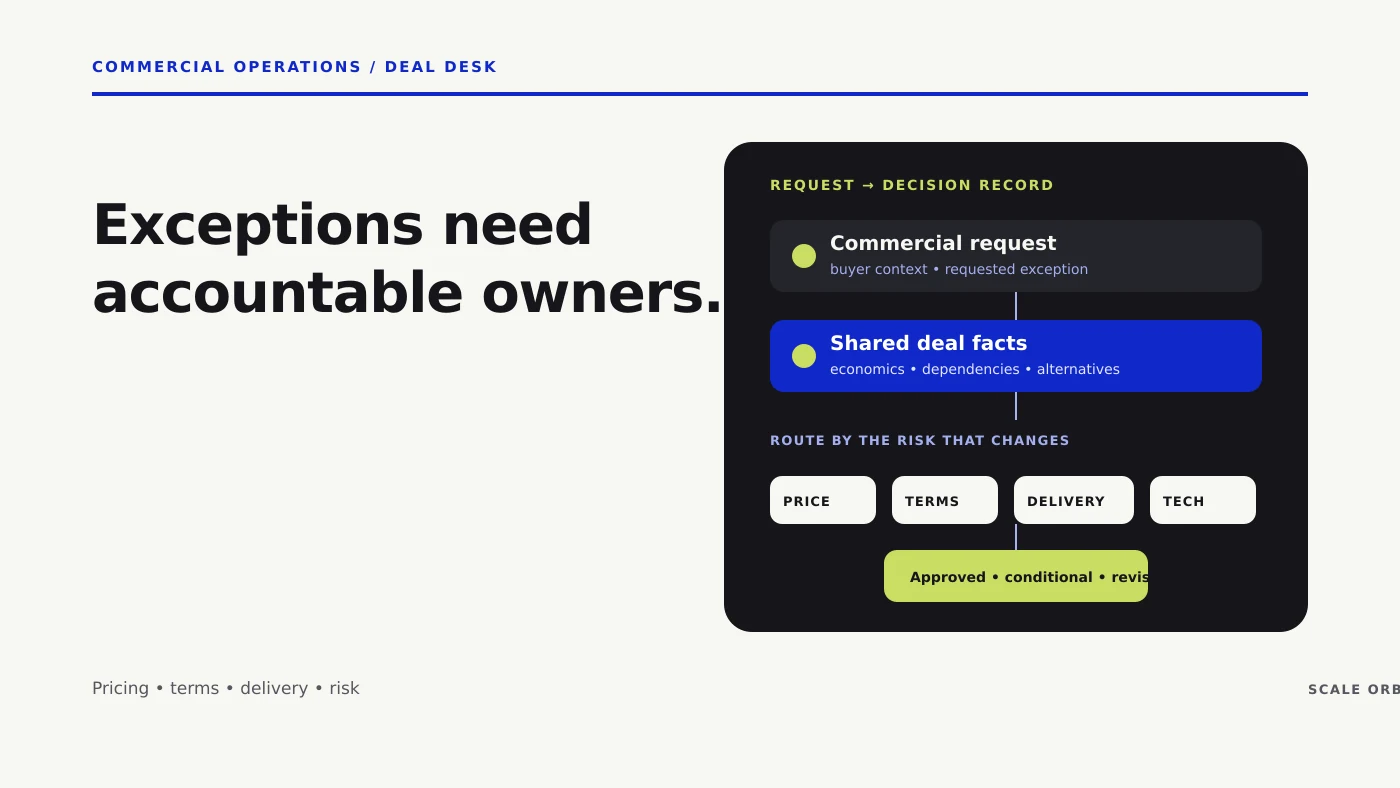
A B2B deal desk is a decision process for commercial exceptions that cross team boundaries. It helps sales, finance, legal, product, and delivery evaluate the same request against shared facts. The goal is not to add a committee to every opportunity. It is to make unusual pricing, terms, scope, and risk visible early enough for the right person to decide.
For a smaller company, the “desk” may be a named owner and a documented review path. A dedicated team is only useful when the volume and complexity justify it. In either case, the process should answer four questions: what is being requested, why the standard offer does not fit, who owns the decision, and what must be recorded if the exception is approved.
Decide which requests enter the review path
Start by defining the exceptions that can change deal economics, delivery commitments, or risk. Common triggers include:
- A discount, rebate, credit, or payment schedule outside the approved offer.
- Contract language that changes renewal, liability, termination, or service obligations.
- A custom implementation, integration, service level, or delivery date.
- A security, data, or product commitment that depends on work not yet approved.
- A bundle or commercial structure that changes how revenue or service effort is understood.
These are examples, not a universal trigger list. Review what has actually caused rework, margin loss, delayed signatures, or delivery friction in the company. A request that has a standard answer should stay on the fast path; a request that changes the business commitment should be visible.

Make the request complete before it reaches an approver
Approval quality is limited by the information in the request. Ask the account owner to submit one short record with:
- Buyer context: account, opportunity, decision participants, business need, and decision timing.
- Requested change: the exact price, term, scope, or commitment being requested, compared with the standard offer.
- Reason: what buyer constraint or decision condition the exception addresses.
- Economics: expected contract value and term, known variable delivery costs, concession value, and any assumptions that still need confirmation.
- Delivery impact: work, capacity, dependencies, acceptance conditions, and accountable delivery owner.
- Alternatives: the closest standard option, a smaller concession, phased scope, or a reason none would resolve the buyer’s issue.
Keep facts separate from assumptions. If the customer has not confirmed a condition, label it as an open question. Do not present platform-reported pipeline or an unsigned forecast as booked revenue.
Route decisions by the risk they change
One senior approver should own the decision record, but that person should not silently approve every specialist concern. Route only the relevant part to the accountable function.
| Request type | Decision owner to involve | Evidence needed |
|---|---|---|
| Price or incentive exception | Sales and finance | Net price, term, concession, variable cost assumptions, and buyer rationale |
| Contract or payment term | Legal and finance | Requested language, business reason, exposure, and fallback position |
| Custom scope or delivery promise | Delivery or product owner | Work estimate, dependencies, capacity, acceptance criteria, and responsible owner |
| Security, data, or integration commitment | Security or technical owner | Current capability, data flow, required work, and unresolved controls |
The company should set its own approval authority and monetary limits. A threshold that works for one deal size, product margin, or risk profile may be inappropriate for another. Document who can approve, who can recommend, and who must be consulted. Avoid a process where “everyone is accountable” and no one is.
Record the decision so delivery can honor it
Use a short set of decision outcomes: approved as requested, approved with named conditions, revise and resubmit, or declined with a standard alternative. Record the approver, date, rationale, expiry if the offer is time-bound, and any condition that changes what the buyer receives.
When an exception is approved, carry its details into the contract, CRM record, order handoff, and delivery plan. A comment buried in a chat thread is not a reliable source of truth. Make the approved version easy for the account team and delivery owner to find.
Measure quality, not only approval speed
Track whether requests arrive complete, how long each risk type takes to decide, how often exceptions recur, and whether approved conditions reach delivery intact. Compare expected economics with realized economics when the relevant data is available and finance agrees on the method.
Fast decisions are useful only when the process protects decision quality. A low approval time can hide missing review or informal promises. Review denials and delays too: repeated requests may expose unclear packaging, weak standard terms, or a sales enablement gap.
Start small and remove avoidable friction
Begin with the exceptions that cause the most meaningful rework. Assign one process owner, publish a concise intake form, and test the route on a small number of live opportunities. Ask the reviewers which facts were missing and remove fields that never affect a decision.
The discount economics in this B2B discount-floor guide can inform pricing review. For buyer-facing scope and value, see the B2B proposal guide.
The useful test is simple: can the team explain what changed, who accepted the risk, and what was promised to the buyer without reconstructing the decision from messages? If not, improve the record before adding more approval layers.
How did this article land?
Choose one reaction. You can change it anytime.