

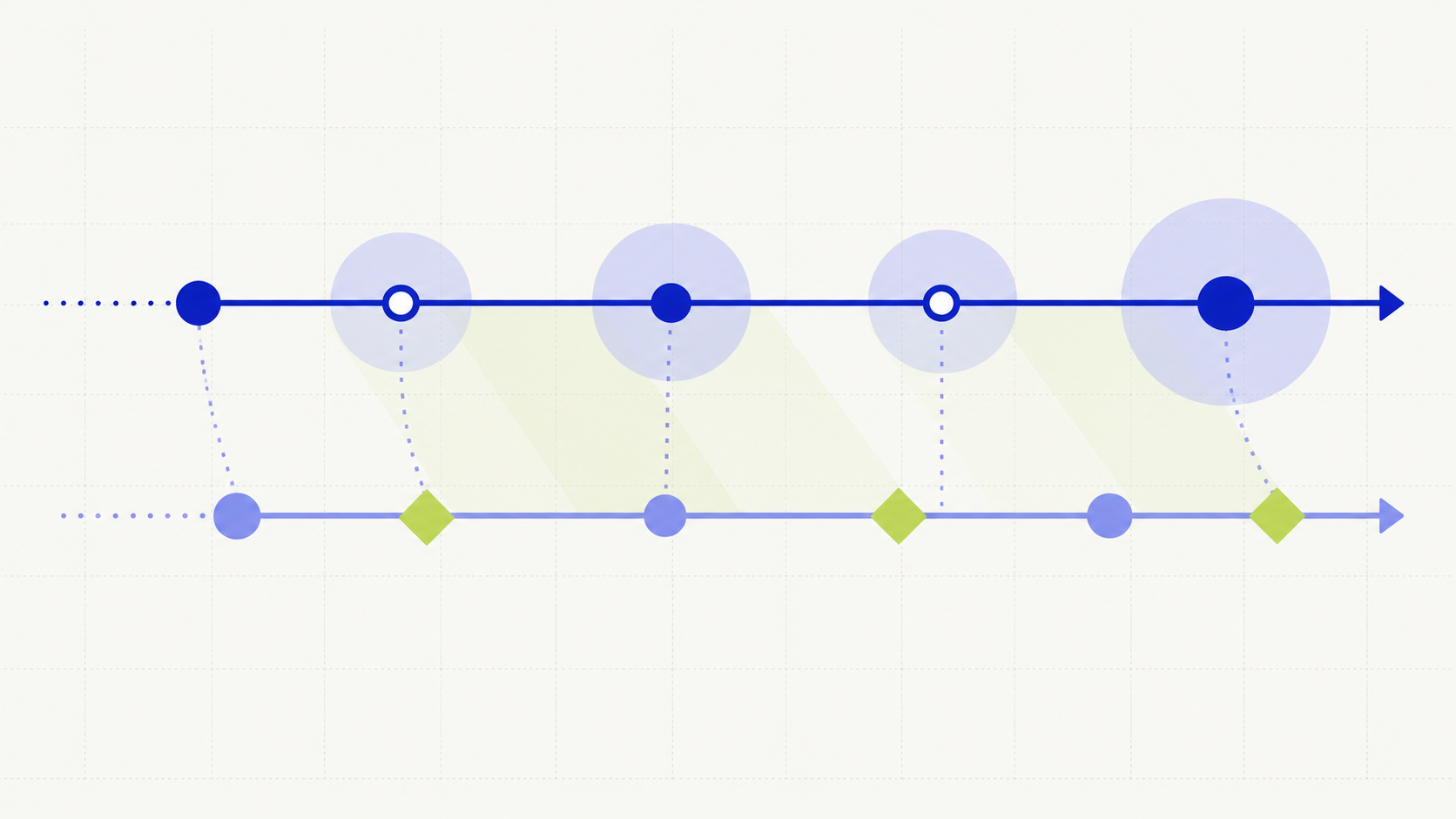
The buying cycle describes how an organization recognizes a problem, evaluates options, builds internal agreement, and makes a decision. The sales cycle describes the seller’s tracked process for qualifying, progressing, and closing a potential deal. The timelines may overlap, but they do not necessarily begin or end together.
For reporting, define both clocks separately. A buyer may research before the first known CRM event; a seller may complete several tasks while the buying group has not changed its decision. Treating seller activity as buyer progress makes pipeline reports look more certain than the evidence supports.
Two clocks answer different questions
| Lens | Buying cycle | Sales cycle |
|---|---|---|
| Primary unit | The organization and its buying group. | The seller’s qualified record or opportunity. |
| Start | A buyer need or evaluation begins, often before the seller can observe it. | A defined CRM event, such as sales acceptance or opportunity creation. |
| Evidence | Buyer-stated problem, evaluation criteria, internal stakeholders, approvals, or timing. | Recorded qualification, discovery, validation, proposal, negotiation, and outcome. |
| End | The organization selects, rejects, delays, or implements a solution. | The seller records a defined closed-won or closed-lost outcome. |
| Visibility | Partly hidden; some progress is learned only through buyer conversations. | More visible when the seller maintains consistent CRM timestamps and stages. |
| Best use | Understand buyer readiness and where decisions need support. | Compare the seller’s process, capacity, and elapsed time. |
Why the distinction changes pipeline reporting
A single average can hide several different problems. A long recorded sales cycle might reflect a slow internal response, a complex buying group, procurement, a real change in buyer priority, or a CRM start date that differs by team. A seller can also move an opportunity forward by sending a proposal without evidence that the buyer has completed evaluation.
The terms “buying cycle” and “sales cycle” are used differently across companies. The operational definitions below are a recommended measurement contract. The existing B2B sales-cycle measurement guide explains how to define the seller’s clock; this article shows how to keep the buyer’s progress distinct.
Define the two timelines before comparing results
- Choose one sales-cycle start. Use the same CRM event for every record in the report, such as accepted opportunity creation. If you also need lead-to-close time, report it as a separate measure.
- Choose the sales-cycle end. Decide whether the report ends at closed won, closed lost, or another defined outcome. Do not mix signed contract dates with CRM stage dates.
- Record buyer progress as evidence. Capture a buyer-confirmed need, evaluation criterion, stakeholder, approval, or timing only when a person has evidence for it. Label unknown fields as unknown.
- Map evidence to stage exits. A stage should change when the required buyer evidence exists, not simply because the seller completed an internal task.
- Group comparable cohorts. Compare by segment, sales motion, product, and period where those differences change the process.
Use buyer evidence to validate sales stages
| Seller stage | Evidence that the buyer may have progressed | Activity that is not enough by itself |
|---|---|---|
| Discovery | The buyer explains a business problem, impact, stakeholders, and decision context. | A meeting was held, but no buyer need or next step was recorded. |
| Evaluation | The buying group confirms criteria, compares options, or tests a relevant requirement. | A proposal was sent or a demo occurred without buyer feedback. |
| Decision process | The buyer identifies approvers, procurement steps, risks, and a decision path. | The seller’s forecast date changed without a buyer-confirmed reason. |
| Closed | The buyer has made a decision and the CRM outcome reflects the agreed definition. | A verbal indication is treated as signed revenue before the company’s close rule is met. |
Use the gap between buyer evidence and seller work as a diagnostic
Once the clocks are separate, inspect the intervals between known events. Time from an eligible inquiry to first human response can reveal routing or coverage delay. Time from discovery to confirmed evaluation criteria can reveal whether the next conversation is useful. Time between an agreed decision step and a CRM update can reveal process hygiene.
These intervals do not automatically identify the responsible team. A pause can be caused by a buyer’s internal review, limited seller capacity, missing information, procurement, or a stalled deal. Use stage notes and buyer-confirmed evidence before assigning cause.
Illustrative scenario: one opportunity, two timelines
Illustrative example, not a client result: A buying group begins researching a reporting problem, later submits a demo request, meets with a seller, brings finance into evaluation, and then pauses while reviewing security requirements. Marketing may first observe the demo request; sales may start its cycle at opportunity creation. The CRM can measure the seller’s elapsed time from that agreed start, while the buyer timeline records the known evaluation and approval milestones. Neither clock reveals the buyer’s full private research period.
Build a report that keeps the measures separate
| Report measure | Use it to answer | Do not interpret it as |
|---|---|---|
| Lead response time | How quickly did a person respond after a defined eligible event? | The total time the buyer has been considering a purchase. |
| Sales-cycle length | How much time passed between the CRM-defined start and outcome? | The complete buying cycle from first need to decision. |
| Stage age with evidence | Where do qualified opportunities remain without a confirmed next buyer milestone? | Proof that the buyer has lost interest. |
| Buying-group coverage | Which decision roles or approvals are known for the opportunity? | A complete map of every person involved. |
| Closed outcomes by cohort | How do comparable records progress under the same definitions? | A universal benchmark for every segment or deal. |
Keep stage definitions tied to observable progress
Review stage rules with sales and marketing together. The guide to opportunity exit criteria can help turn buyer evidence into a consistent CRM rule. Use the B2B marketing funnel guide to connect market and lead progression without treating every marketing event as a sales milestone.
Keep the buying clock honest: mark when the buyer’s process is first observed, preserve unknown time as unknown, and separate that from the seller’s recorded cycle. That gives leaders a cleaner way to diagnose delays without crediting or blaming a team for progress the CRM cannot prove.
How did this article land?
Choose one reaction. You can change it anytime.